Science and Purity: The Biochemistry of Raw Honey
From thermolabile enzymes to the HMF index: discover why physical integrity is synonymous with superior quality.
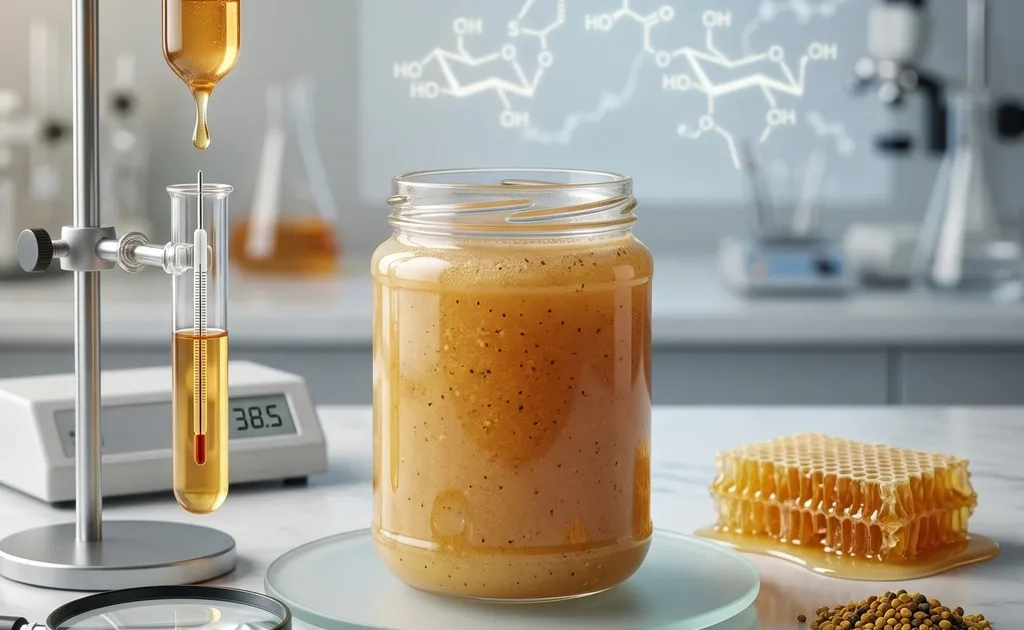
Science and Purity: The Truth About Raw Honey
Honey is a complex and delicate biochemical matrix. To keep its properties intact, it must be treated with scientific rigour, avoiding any thermal stress whatsoever.
The Markers of Quality
- Enzymatic Integrity: Enzymes such as diastase are the bio-catalysts of honey. Their presence testifies that the honey has never been heated above 40°C.
- HMF Index: Hydroxymethylfurfural is the thermometer of freshness. The lower it is, the younger and more correctly stored the honey.
- Raw Honey: A product that does not undergo industrial microfiltration, thus preserving its natural complement of pollen and propolis.
Our mission is to protect this natural architecture, guaranteeing a biologically alive product.
The Concept of Terroir in Honey: A Botanical Grand Cru
In the universe of haute gastronomy, the concept of terroir is usually associated with fine wines or single-origin Specialty Coffees. However, this notion finds its ultimate and most complex expression precisely in premium apiculture. An ultra-premium artisanal honey is not a mere sugar solution, but rather a liquid photograph of an ecosystem at a precise moment in the year.
The interaction between the plant’s genetics, the mineral composition of the soil (the pedoclimate), the altitude, and the seasonal weather patterns creates a unique and unrepeatable nectariferous synthesis. Bees act as territorial micro-selectors, gathering and concentrating the essence of specific botanical crus. This process elevates honey from a simple sweetener to a veritable meditation ingredient, capable of expressing aromatic nuances that range from leather to undergrowth, from white flowers to toasted nuts.
The true grandeur of a luxury honey lies in its absolute traceability and its capacity to unequivocally reflect its territory of origin, rejecting the standardisation and blending typical of large-scale commercial products.
Which factors determine the organoleptic profile of a natural honey?
The organoleptic profile of a natural honey is determined exclusively by the botanical origin of the nectar, the composition of the flower’s volatile compounds, and the pedoclimatic specificities of the territory. Cold extraction methodologies preserve these complex chemical and sensory fingerprints intact.
Delving into the details of this aromatic architecture, the flavour, aroma, and colour of a honey derive from a sophisticated blend of trace elements that accompany the sugar component. When forager bees collect nectar, they inadvertently gather miniscule quantities of essential oils, polyphenols, carotenoids, and flavonoids specific to the visited plant.
- Colour: It is primarily modulated by the concentration of minerals (such as iron, copper, and manganese) and natural plant pigments. A chestnut honey will present with dark amber hues and reddish reflections due to the richness of tannins and flavonoids, whereas an acacia honey will appear almost transparent, akin to spring water.
- Aroma (Olfactory Bouquet): It is the result of hundreds of Volatile Organic Compounds (VOCs), including esters, aldehydes, ketones, and alcohols. These thermolabile compounds are the first to vanish if the product undergoes pasteurisation, which is why cold extraction is the only way to maintain the original aromatic bouquet.
- Taste and Touch: The acidic structure (guided by gluconic acid) balances the sweetness, whilst the presence of specific suspended pollens contributes to defining the texture and consistency perceived on the palate.
The Sensory Architecture: Sugars, Acids, and Volatile Compounds
Analysing honey from a chemical perspective means exploring a supersaturated system of extraordinary elegance. The backbone of honey is constituted by carbohydrates, which represent approximately 80% of its weight, accompanied by a percentage of natural moisture which, in a high-end product, must be rigorously maintained below 18% to prevent unwanted fermentative processes.
The main protagonists are the monosaccharides:
- Fructose (Levulose): Responsible for the superior sweetening power and the hygroscopic tendency of honey. A high percentage of fructose (as in acacia or chestnut nectars) guarantees a permanently liquid physical state.
- Glucose (Dextrose): Provides structure and governs crystallisation dynamics. Its lower solubility compared to fructose triggers physical changes over time.
Balancing this massive sugary presence is the acidic complement. The pH of a raw honey oscillates between 3.4 and 6.1. The primary driver of this acidic reaction is gluconic acid, generated by the action of the glucose oxidase enzyme (added by the bees) upon the glucose. This acidity is a crucial element in haute cuisine, as it confers a freshness on the palate that makes the honey ideal for complex pairings, cleansing the tongue and preparing the taste buds for the next bite.
Why does raw honey crystallise over time?
Raw honey crystallises due to the supersaturation of natural sugars within it. Glucose, being significantly less soluble than fructose in an aqueous base, tends to precipitate, separating from the water and forming a solid reticular structure. This physical process confirms the absence of industrial thermal treatments.
Crystallisation is, in fact, the greatest visual guarantee certificate for a discerning consumer. In the mass market, crystallisation is often viewed as an aesthetic defect, prompting industries to pasteurise the honey (heating it to temperatures above 70°C) to melt the crystals and destroy the primary condensation nuclei. This practice guarantees a perpetually liquid shelf presence, but irretrievably devastates the enzymatic and volatile structure of the product, dramatically raising HMF values.
In the realm of luxury artisanal honey, crystallisation is instead a studied, guided, and valorised phenomenon:
- The Glucose/Water Ratio: Determines the speed of the process. Honeys such as dandelion or sunflower crystallise within days of extraction.
- Storage Temperature: The thermodynamics of crystallisation accelerate maximally at around 14°C.
- Fine Crystallisation: An excellent honey manages crystallisation by developing imperceptible micro-crystals, which transform the matrix into a fondant cream, velvety and melting on the palate—a masterpiece of texture highly sought after by Michelin-starred chefs.
Melissopalynological Analysis and Territorial Imprint
The true identity card of a raw honey is written in its sediments. Through melissopalynological analysis—the study of pollens contained within the honey—it is possible to map the bees’ flight area with millimetric precision, verifying the authenticity of the cru.
Unlike industrial microfiltration, which pumps honey at high pressures through ultra-fine mesh filters to eliminate every solid particle (rendering the product anonymous and impossible to trace), simple cold settling and artisanal macro-filtration keep in suspension:
- Pollen grains: Which unequivocally certify the botanical and geographical origin (e.g., the presence of Eucalyptus camaldulensis pollen for an Agro Pontino honey).
- Traces of propolis and capping wax: Which enrich the aromatic bouquet, imparting balsamic and resinous notes of extreme elegance.
This physical integrity transforms the jar of honey into a botanical and geological archive, wherein every spoonful yields the exact information of the territory in which it was generated.
Biodiversity and Pedoclimate: The Excellence of Rome and Lazio
Positioning honey as a gourmet product inherently requires exploring territorial specificities. Rome and the entire Lazio region offer a pedoclimatic theatre of exceptional value, characterised by an extreme heterogeneity of soils and microclimates that allow bees to elaborate nectars of rare complexity.
The Lazio territory enables the production of ultra-premium references, distinguishable as veritable Grand Crus:
- The Chestnut of the Monti Cimini and Tuscia Viterbese: Volcanic soils rich in potassium and phosphorus yield a dark, dense honey with an imposing organoleptic profile. Astringent notes, aromas of damp undergrowth, leather, and bitter cocoa bean. A masterpiece for pairing with cave-aged cheeses.
- The Eucalyptus of the Pontine Plain: The historic land reclamation and the planting of windbreaks have created a unique micro-ecosystem. The resulting honey presents a compact crystallisation and delivers unmistakable notes of salted caramel, dried mushrooms, and liquorice, offering a profound tactile and gustatory experience.
- The Polyflora (Millefiori) of the Roman Campagna and Appia Antica: In pristine ecosystems bordering the Capital, the floral biodiversity of spring and summer (encompassing cardoons, clovers, brambles, and wild mint) is captured in a polyfloral honey. Its aromatic complexity can never be standardised: each vintage yields a different balance of floral, fruity, and spiced notes.
These excellences demonstrate how luxury honey is not a mere agricultural byproduct, but the result of respectful land management, highly precise nomadic or stationary apiculture, and a cellar craftsmanship that admits no compromises.
The Art of Tasting: Honey in Haute Cuisine
Consuming premium-tier honey requires a methodological approach akin to that reserved for ageing wines or bean-to-bar chocolates. Sensory analysis unfolds in three distinct phases, designed to exalt every nuance of the biochemical matrix:
- Visual Examination: Evaluating the brilliance, the chromatic scale (from water-white to almost black, measured in Pfund millimetres), and the physical structure (clarity of liquid honey or grain of crystals in crystallised honey).
- Olfactory and Retronasal Examination: Bringing the honey to the temperature of the oral cavity releases the volatile compounds. An expert taster will be able to isolate the dominant aromatic families: floral, fruity, warm, woody, chemical, or animal. The length of the aromatic return (persistence) is a direct indicator of enzymatic integrity and the absence of thermal stress.
- Gustatory and Tactile Examination: Analysing the balance between fundamental flavours, particularly the interaction between pure sweetness and natural acidity, whilst simultaneously evaluating texture, adhesiveness, and solubility on the palate.
In luxury dining, raw honey abandons the role of a simple sweetener to become a structural ingredient. The balsamic notes of a eucalyptus are utilised to glaze strongly flavoured meats, exploiting the Maillard reaction at low temperatures; the astringency of the chestnut becomes the perfect counterpoint for blue cheeses or aged Pecorino Romano PDO, creating a gustatory bridge built upon the territorial contrasts of Lazio.
Conservation: Protecting the Product’s Integrity
Respect for the raw material must necessarily extend to storage methods. Being a biologically alive product, rich in thermolabile enzymes (such as invertase and glucose oxidase), its excellence is temporary if not supported by correct conservation.
The primary enemies of honey’s integrity are direct light and heat. Prolonged exposure to temperatures above 25°C rapidly degrades the aromatic structure and inexorably accelerates the rise of the HMF index. An ultra-premium honey requires storage in cool, dark environments at a constant temperature, exactly as befits a bottle of vintage wine.
To purchase, taste, and conserve a raw honey ultimately means participating in a rite of preservation: the custodianship of a small, perfect, and ephemeral biochemical work of art, created by the terroir and sculpted by the bees.