Origins and Flowers: Discovering the Lazio Terroir
A journey through spontaneous blooms and the unique microclimate that define the identity of Lazio honey.
Origins and Flowers: The Geography of Nectar
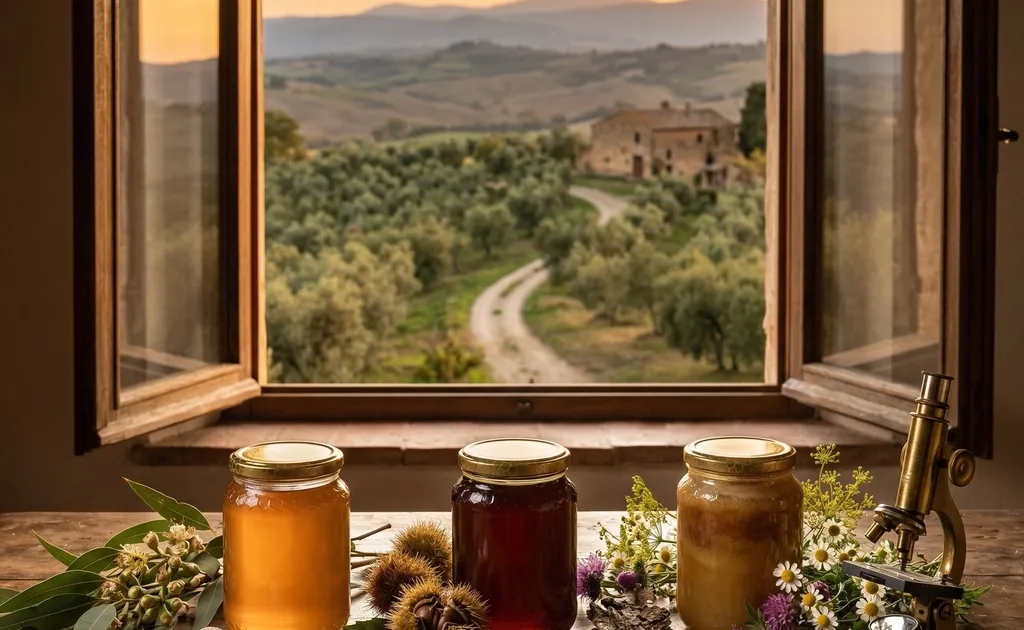
Honey is not all the same: it is the liquid expression of the place where it is produced. In the landscape of haute gastronomy, the concept of terroir is not exclusive to fine vintage wines or single-origin coffees. In Lazio, this notion manifests through iconic blooms, geologically varied soils, and complex microclimates that elevate honey into a veritable botanical and sensory masterpiece.
What elements define the terroir of an artisanal honey?
The terroir of an artisanal honey is defined by the interaction between the botanical origin of the nectar, the geological composition of the soil, the altitude, and micro-climatic variables. These factors, combined with the bees’ foraging radius, create an absolutely unrepeatable chemical and sensory fingerprint.
Delving into this complex natural architecture, it is fundamental to understand that bees act as highly precise environmental sensors. Flying within an average radius of three kilometres from the hive, they forage nectar that is directly influenced by the condition of the soil in which the plant roots itself. The Lazio pedoclimate, characterised by significant thermal excursions, proximity to the sea, and a geological framework of volcanic matrix, decisively influences the nectar secretion of the plants, modulating the concentration of sugars, free amino acids, and Volatile Organic Compounds (VOCs).
Raw honey, cold-extracted and untouched by industrial processes of microfiltration or pasteurisation, manages to capture and crystallise this geographical photograph. The absence of thermal stress keeps the array of enzymes and phytonutrients intact, allowing the taster to perceive in the glass (or on the tasting spoon) the very same aromatic nuances that permeated the air of the apiary at the time of the harvest.
The Territory’s Excellences: Sensory Mapping of Lazio
The Lazio region offers an ecosystemic diversity that translates into monofloral and polyfloral honeys with distinct, recognisable organoleptic characteristics of the highest prestige. Let us analyse the macro-areas of excellence.
The Agro Pontino: Eucalyptus and Coastal Sapidity
The historic land reclamation of the Agro Pontino redesigned the landscape, introducing imposing windbreaks of eucalyptus (Eucalyptus camaldulensis). This plant found its ideal habitat in the clay-sandy soil and the microclimate mitigated by the Tyrrhenian Sea, giving rise to one of the most appreciated expressions of eucalyptus honey in haute cuisine.
- Sensory Profile: Pontine eucalyptus honey is characterised by a medium-fine crystallisation, which grants it a compact yet fondant texture on the palate.
- Olfactory Bouquet: Surprisingly, it does not smell of mint or pungent balsam; rather, it releases notes of dried mushrooms, helichrysum, dark caramel, and wet wood.
- Taste: On the palate, it presents a contained sweetness, balanced by a distinct sapidity conferred by the marine aerosol, followed by a lingering finish of liquorice and toffee.
This reference is a cornerstone of local gastronomy, serving as an aromatic bridge for complex marinades or as an accompaniment to medium-aged spun-paste cheeses.
The Monti Cimini and Lucretili: The Grandeur of Chestnut
Moving northwards into the Tuscia Viterbese (particularly on the Monti Cimini) and eastwards onto the Monti Lucretili, the landscape is dominated by ancient chestnut forests (Castanea sativa). Here, nomadic or stationary apiculture requires immense mastery, as the summer bloom is brief and intensely explosive.
- Visual Analysis: Chestnut honey remains in a liquid state for a prolonged period (due to a high fructose/glucose ratio), exhibiting chromatic hues that range from dark amber to mahogany, with reddish reflections and a crystalline clarity.
- Aromatic Architecture: It is a “meditation honey”. Olfactorily, it expresses pungent, phenolic notes of leather, blonde tobacco, and damp undergrowth.
- Gustatory Development: The entry in the mouth is warm, but the sweetness is immediately overwhelmed by an elegant astringency deriving from the high presence of natural tannins and flavonoids. The finish is decidedly bitter, clean, and sharp, akin to that of a raw cocoa bean or an oxidised black tea.
How does volcanic soil influence the sensory profile of honey?
Volcanic soil enriches the nectar with specific microelements and mineral salts, particularly potassium and manganese, altering the product’s electrical conductivity. On the palate, this translates into a sapid, complex gustatory structure with elegant earthy and metallic nuances.
The volcanic districts of Lazio (the areas surrounding Lakes Bolsena, Vico, Bracciano, and the Castelli Romani) provide the woodland formations with a phenomenally rich mineral substrate, derived from millennia-old ashes, pumice, and tuffs. Electrical conductivity, measured in milliSiemens per centimetre (mS/cm), is a fundamental analytical parameter that reaches very high values in chestnut or honeydew honeys from these zones.
These mineral salts, absorbed by the plant’s sap and transferred into the nectar, act as natural flavour enhancers within the honey’s complex sugar matrix. Furthermore, the richness in polyphenols of plants grown on volcanic soils contributes to slightly lowering the honey’s pH and increasing its intrinsic antioxidant power, rendering it not only a product with a more intense flavour but also one that is chemically more stable and resistant to oxidative phenomena over time.
The Roman Campagna: Biodiversity and Polyflora (Millefiori)
If monofloral honeys represent the solo of an instrument, the Millefiori (or polyflora) honey of the Roman Campagna is an entire symphony orchestra. Across the vast pristine expanses, within the archaeological parks (such as the Appia Antica Park), and in the agricultural estates surrounding the Capital, the floral biodiversity is boundless.
The production of Millefiori is the apotheosis of the annual terroir concept. It is never replicable: each season yields a different “vintage”, guided by the spring and summer rainfall and temperatures.
- Spring Millefiori: Dominated by the early blooms of asphodel, clover, dandelion, and prunus. It usually presents with pale, almost straw-like hues and crystallises rapidly into a creamy white paste. To the nose and palate, it offers sensations of white flowers, fresh almond, vanilla, and sugared almond (confetto). An ethereal honey of whispered elegance.
- Summer Millefiori: Gathers robust nectars, including cardoon, bramble, wild calamint, bird’s-foot trefoil, and alfalfa. The colour veers towards a luminous amber. The crystallisation is more irregular, and the gustatory structure explodes into notes of candied fruit, warm hay, sweet spices, and a slight balsamic hint on the finish, conferred by the spontaneous labiates.
This intrinsic variability is the true gastronomic luxury. Great chefs seek out the Millefiori of the Roman Campagna precisely for its unrepeatability, utilising it to define seasonal menus and to create gustatory pairings impossible to achieve with standardised, blended products.
Melissopalynological Analysis and Absolute Traceability
In the luxury food and wine sector, authenticity must be scientifically proven. An organoleptic examination, however refined, is insufficient. The guarantee of territorial origin for an ultra-premium Lazio honey is certified through melissopalynological analysis.
This fascinating scientific discipline consists of observing honey sediments under a microscope to identify and quantify the pollen grains present within it. Because bees collect nectar by visiting flowers, small quantities of pollen inevitably fall into the nectar droplet or become entangled in the insect’s hairs, ultimately ending up stored in the wax cells.
A melissopalynological analysis conducted on an artisanal Lazio honey will reveal:
- The Dominant Pollen: Which dictates (alongside chemical, physical, and organoleptic analyses) the monofloral denomination (e.g., >90% for a chestnut honey; as chestnut pollen is under-represented, legal thresholds are highly specific).
- The Secondary Pollen Spectrum: The true geographical signature. Finding pollens of Erica arborea, broom, or specific spontaneous orchids alongside the dominant pollen certifies that the honey can only originate from a precise area of Central Italy.
Industrial processing, through microfiltration, deliberately removes these pollens to delay crystallisation and obtain a perpetually transparent liquid. By doing so, however, it erases the honey’s fingerprint, stripping it of its geographical and botanical identity. Raw honey, conversely, jealously preserves this microscopic yet invaluable wealth of information.
Lazio Honey in Haute Cuisine: Pairing Examples
Positioning honey as a gourmet ingredient means understanding its chemical and gustatory interactions with premium raw materials. The extreme variety of the Lazio terroir offers extraordinarily effective pairings, playing upon the principles of balance or contrast.
- Cimini Chestnut and Pecorino Romano PDO: The territorial pairing par excellence. The intense sapidity and crumbly texture of a highly aged Pecorino Romano find a perfect contrast in the tannic astringency and bitter finish of the chestnut honey. The two strong components mutually neutralise, cleansing the palate and revealing unexpected roasted notes.
- Pontine Eucalyptus and Lepini Mountains Black Pig Pork: Used during the final glazing phase, eucalyptus honey (rich in fructose) triggers a controlled Maillard reaction that creates a crispy lacquer. The honey’s liquorice and dried mushroom notes wed magnificently with the sweet fat of the local meat.
- Spring Millefiori and Fresh Roman Sheep’s Milk Ricotta: A pairing of consonance. The delicate, lactic sweetness of artisanal ricotta is elevated by the ethereal, vanilla, and floral notes of the pale honey, creating a plated dessert of absolute minimalism and elegance.
Physico-Chemical Integrity as the Guardian of the Terroir
The entire narrative linked to origin, flowers, and soil collapses instantaneously if the honey is subjected to thermal stress or pasteurisation during the extraction and packaging phases. The terroir’s imprint is extremely volatile: it relies upon chains of aldehydes, ketones, and esters that evaporate rapidly at temperatures above 40-45°C.
For this reason, the certification of excellence for a Lazio honey is strictly tied to its biochemical markers of freshness:
- A low HMF Index (hydroxymethylfurfural), a molecule formed by the dehydration of sugars in an acidic environment, accelerated by heat. A value close to zero certifies absolute freshness and cold extraction.
- A high concentration of native enzymes, such as diastase and invertase.
Choosing a raw honey sourced from the geographical excellences of Lazio means undertaking a gesture of profound gastronomic culture. It means rewarding an incredibly short artisanal supply chain, safeguarding biodiversity, and granting oneself the privilege of tasting a perfect synthesis between nature’s botanical engineering, the ancestral composition of the soil, and the meticulous, tireless art of the bees.