The Art of Tasting: A Guide to Sensory Analysis
Master the technical protocol for evaluating the colour, aroma, and persistence of authentic artisanal raw honey.
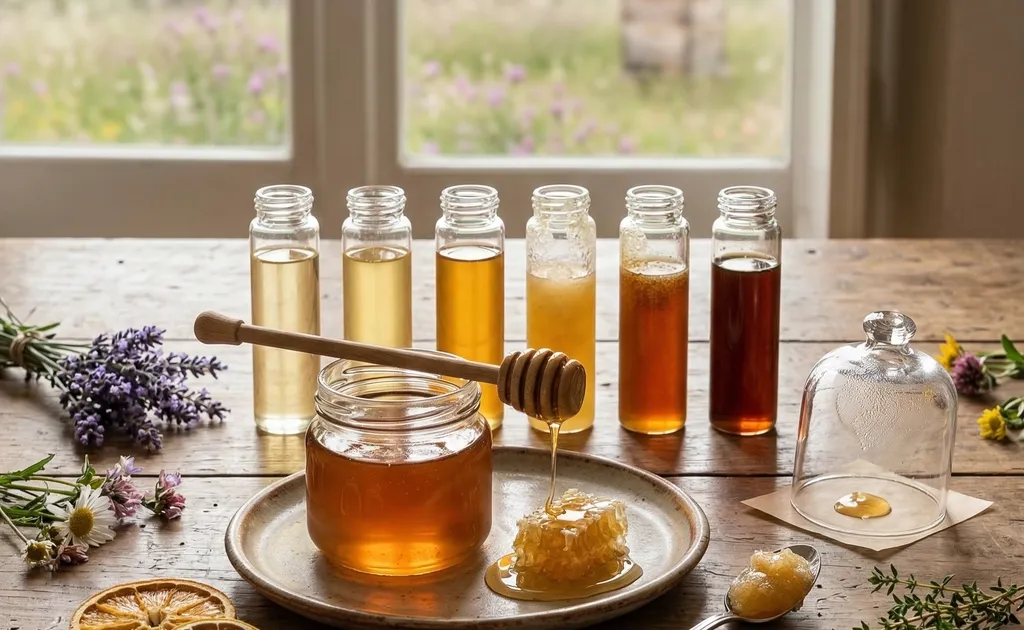
The Art of Tasting: Sensory Analysis
Tasting honey is never a mere sampling; it is a conscious act that engages all the senses. Through sensory analysis, we learn to read the history of the terroir and the tireless work of the bees.
The Phases of the Technical Protocol
- Visual Examination: Evaluating the chromatic tone using the Pfund scale and the physical state (liquid or crystallised).
- Olfactory Examination: Identifying primary and secondary aromas. An exceptional honey expresses complex bouquets, not merely sweetness.
- Gustatory and Tactile Examination: Analysing the texture of the crystals, solubility, and aromatic persistence in the aftertaste.
Developing an educated palate is the primary defence for distinguishing an authentic product from industrial blends.
Sensory Analysis in Haute Gastronomy: A Scientific Approach
Within the landscape of luxury food and wine, artisanal, raw, and intact honey demands the same methodological reverence reserved for Grand Cru wines or Specialty Coffees. Sensory analysis is not purely a poetic exercise, but a rigorous protocol of biochemical decoding. Every visual, olfactory, and tactile nuance yields precise information regarding botanical origin, enzymatic integrity, and the absence of thermal stress.
The expert taster transforms into an interpreter of the pedoclimate: through the senses, one “reads” the complex architecture constructed by the bees, mapping the ecosystem in which they foraged, and verifying the absolute purity of a product that, to express excellence, must remain raw and alive.
How to Perform the Visual Examination and Chromatic Evaluation of Raw Honey
The visual examination is conducted by evaluating the chromatic tone via the Pfund optical scale, observing the clarity of the liquid nectar or the granulometry of the crystallised one, and verifying the absence of anomalous separations. This phase instantaneously reveals the botanical origin and structural integrity of the artisanal product.
Deepening this initial and fundamental investigation, the taster should hold the honey sample (preferably served in a tasting glass or on a dedicated white ceramic spoon) against a source of natural or calibrated light.
The visual analysis breaks down into crucial technical parameters:
- The Pfund Scale: This is the international unit of measurement (expressed in millimetres) used to classify the colour of honey. It ranges from values close to zero for water-white honeys (such as certain selections of acacia or asphodel, which are almost transparent) to over 114 mm for dark amber references (like chestnut honey or forest honeydew, bordering on mahogany).
- Turbidity and Sediments: Unlike the industrial product, which undergoes drastic microfiltration at high temperatures to appear perpetually clear and brilliant, a high-end raw honey will exhibit a slight, elegant turbidity. This opalescence is nature’s precious signature: suspended pollen particles (essential for melissopalynological analysis), minuscule traces of propolis, capping beeswax, and micro-bubbles of air incorporated during cold extraction.
- The Architecture of Crystallisation: If the honey is in a solid state, the compactness and homogeneity of the mass are evaluated. A white surface veining, known as “frosting” or marbling, is not a defect, but clear evidence that the honey, upon contact with the glass walls in a low-temperature environment, has contracted its sugar matrix, trapping air. It is a definitive indicator of the total absence of pasteurisation.
The Olfactory Bouquet: Decoding Volatile Organic Compounds
The olfactory examination is undoubtedly the most complex and intellectually stimulating moment of the tasting. The aroma of honey is conveyed by Volatile Organic Compounds (VOCs), an infinitesimal fraction of the product’s weight (less than 0.001%), yet responsible for its entire aromatic identity.
These compounds (including aldehydes, ketones, esters, alcohols, and phenols) are highly thermolabile. If the honey is heated above 40°C during the potting phase, these compounds sublimate and are lost forever, leaving behind an anonymous sweetener. The fragrance of a true artisanal honey is irrefutable proof of its cold extraction.
To stimulate the release of aromas, it is advisable to “smear” a small amount of honey onto the walls of the glass, thereby increasing the surface area in contact with oxygen, and then inhale deeply. The principal aromatic families recognised in the sensory vocabulary are:
- Floral/Ethereal: Notes of jasmine, orange blossom, white flowers, or rose petals (typical of citrus or spring polyflora).
- Fruity: Reminiscent of fresh fruit, dried apricot, citrus fruits, or preserve.
- Vegetal/Herbaceous: Scents of freshly cut hay, tomato leaves, aromatic herbs, or Mediterranean scrub.
- Warm/Roasted: Aromas of caramel, liquorice, bitter almond, coffee, or cocoa bean.
- Woody/Phenolic: Notes of bark, damp undergrowth, leather, or Russian leather (dominant in Lazio chestnut honey).
Which Factors Determine Tactile Texture and Crystallisation Perceived on the Palate?
Tactile texture is determined by the chemical ratio between glucose and fructose, the natural moisture content, and storage temperatures. These factors trigger the spontaneous crystallisation of the honey, developing a structure that varies from creamy and microcrystalline to compact, crumbly, or sandy.
The moment the honey is introduced into the oral cavity marks the beginning of the simultaneous tactile and gustatory analysis. Physically, the tongue and palate act as both thermometer and calliper. As the honey reaches body temperature (approximately 37°C), the crystals begin to melt gradually. During this phase, the taster evaluates:
- Adhesiveness and Viscosity: In liquid honey, one measures how much the product “grips” the palate before diluting with saliva. A honey with optimal natural moisture (below 17.5%) will present a luxurious and structured viscosity, never watery.
- Granulometry: In crystallised honey, the size of the crystal is analysed. Ultra-premium honeys (such as the Eucalyptus from the Agro Pontino) often present a crystallisation described as “fondant” or “pomade-like”, with imperceptible micro-crystals that melt like butter, creating a velvety and highly refined tactile experience. A coarser crystallisation, albeit natural, offers instead a pleasing interplay of texture and crunch.
- Astringency: A tactile sensation, not a flavour. It is linked to the presence of tannins and polyphenols. In chestnut honey from the Monti Cimini, for instance, a distinct drying reaction is felt on the mucous membranes of the palate—a trait of extreme elegance sought after for grand gastronomic pairings.
The Gustatory Architecture: Beyond Mere Sweetness
The most common error among novices is to stop at evaluating sweetness. Honey is effectively a supersaturated matrix, composed of over 80% monosaccharides (fructose and glucose), but the true greatness of a cru lies in the balance this sweetness establishes with the other gustatory components.
The fundamental flavours identifiable are:
- Sweetness: Varies in intensity based on the sugar ratio. Fructose possesses a noticeably higher sweetening power than glucose. Therefore, honeys rich in fructose (which remain liquid for longer) will attack the palate with a swifter and more pungent sugary sensation.
- Acidity: The true secret of excellence. All honeys are chemically acidic (with a pH usually oscillating between 3.5 and 5.5). This acidity is modulated by gluconic acid, synthesised by the glucose oxidase enzyme added by the bees. Although masked by the sugars, acidity imparts “verticality” and freshness to the product, preventing it from becoming cloying and cleansing the palate admirably.
- Bitterness: Present in a few, highly prized references. In Lazio chestnut honey or the rare strawberry tree (corbezzolo) honey, the bitter component is distinct, deriving from specific glycosides and phenolic compounds present in the nectar. It is a noble bitterness, akin to that of cardoon or artichoke, opening infinite possibilities for haute cuisine.
- Sapidity: Generated by electrical conductivity and the presence of mineral salts (potassium, magnesium, manganese). Honeys produced on volcanic soils or near the maritime coast, such as certain polyfloras from the Roman Campagna, exhibit a sapid nuance that enhances contrasts and bestows three-dimensionality upon the bite.
Retronasal Olfaction and Aromatic Persistence
The concluding phase of the technical tasting occurs after swallowing, through the physiological mechanism of retronasal olfaction. With the mouth closed, the taster exhales air slowly through the nose. The aromatic compounds, now warmed to 37°C and aerosolised, ascend through the nasal choanae, revealing the true soul of the honey.
It is during this phase that the so-called Mouth Aroma manifests. Often, the scents perceived via retronasal olfaction are profoundly different from those isolated during direct (orthonasal) olfactory examination. A honey that appeared only faintly floral to the nose might explode in the mouth with intense notes of exotic fruit, oriental spices, or balsamic hints.
Intense Aromatic Persistence (IAP) is the ultimate yardstick of quality. In a luxury honey, the aromatic return does not vanish in mere seconds, but lingers on the palate for minutes. This sensory longevity certifies the absence of adulteration or industrial refinement.
Sensory Vocabulary of the Lazio Terroir
Applying the sensory analysis protocol to the premium honeys of Lazio means embarking upon a journey through organoleptic profiles of extraordinary identity. Traceability, certified by low levels of the HMF Index (hydroxymethylfurfural) guaranteeing freshness, allows the following crus to express themselves to their absolute fullest potential:
- Eucalyptus of the Agro Pontino: Visually, it often presents finely crystallised, with chromatisms ranging from beige to hazelnut. On the nose, the aroma is of medium intensity, closed upon notes of smoke, dried mushrooms, and wet wood. In the mouth, a caramelised sweetness explodes, balanced by territorial sapidity, with an aftertaste of sweetish liquorice and toffee.
- Chestnut of the Monti Cimini and Lucretili: Exceptionally clear and liquid, dark amber or mahogany in colour. A powerful, penetrating, strongly phenolic olfaction. Gustatorily, the sugary impact vanishes in an instant, overwhelmed by an elegant bitterness and tannic astringency, leaving the mouth perfectly dry and yearning for a pairing with a high-fat cheese or a cave-aged pecorino.
- Polyflora of the Roman Campagna: Its polyfloral nature translates into a chromatic kaleidoscope, from pale gold to light amber. Olfactorily, it is a portrait of the Lazio spring: ethereal notes of asphodel, fruity hints, spontaneous herbs. The tactile texture varies depending on the vintage, but the aromatic persistence is always characterised by a vibrant acidic freshness and finishes of sweet almond or natural vanilla.
Acquiring mastery over these sensory descriptors elevates the act of eating to a moment of supreme gastronomic culture. Knowing how to read, analyse, and respect the complex matrix of a raw honey ultimately means recognising and celebrating the unapproachable genius of nature and the meticulous art of great Italian apiculture.