Biodiversity and Ethics: The Value of Apiculture
Why protecting bees means safeguarding the terroir and ensuring a future for our agriculture.
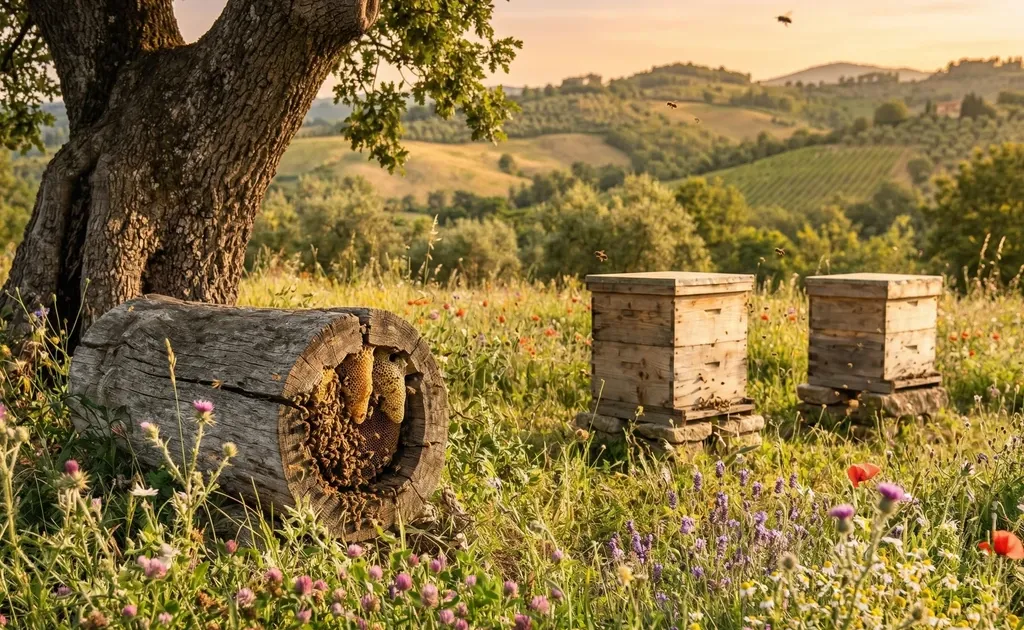
Biodiversity and Apicultural Ethics
Apiculture is, above all, an act of environmental stewardship. Bees are the guardians of biodiversity, and their welfare is the prerequisite for any production of excellence. In the landscape of luxury gastronomy, an exceptional honey is never judged solely by its aesthetics or its aromatic balance, but also by the ecological footprint its production leaves upon the terroir.
What is the Role of Bees as Environmental Bioindicators in Lazio?
Bees act as highly precise environmental micro-sensors. Foraging for nectar, pollen, and water within a radius of approximately three kilometres from the hive, they intercept and bioaccumulate potential pollutants. This allows for the mapping of heavy metals or agrochemicals, yielding an unequivocal analysis of the local ecosystem’s purity.
To fully grasp this extraordinary analytical capability, one must understand the biology of Apis mellifera. A single colony, during the peak of the spring season, can undertake tens of thousands of daily flights, covering an area of over 2,800 hectares. Scout and forager bees alight upon millions of corollas, effectively analysing the quality of the air, soil, and surface waters. Through rigorous monitoring programmes, high-end apiculture utilises pollen and beeswax not merely for production, but as veritable “system logs” of the environment.
In Lazio—a region characterised by immense landscape richness, spanning from the nature reserves of the Monti Lucretili to urban archaeological parks such as the Appia Antica—ensuring that bees operate in a pristine environment is the primary step in obtaining an ultra-premium raw honey. The absence of chemical contaminants is not solely an ethical requirement; it is an essential factor that directly impacts crystallisation kinetics, the vitality of enzymes, and the long-term stability of the Volatile Organic Compounds (VOCs) that forge the finished product’s unmistakable aromatic bouquet.
A Respectful Management Model: The Ethics of Haute Apiculture
Positioning a honey as a Grand Cru of gastronomy necessitates the adoption of an apiary management protocol that far exceeds the baseline requirements of standard organic certifications. Artisanal haute apiculture is founded upon the unconditional respect for the insect’s ethology and its social architecture.
- Beyond Organic: We do not merely abstain from synthetic substances; we adopt an approach of minimal interference. Hive inspections are precisely calibrated so as not to disrupt the thermal and olfactory equilibrium of the colony, which is fundamental for the correct maturation of the honey.
- Respecting Spontaneous Swarming: The natural reproduction of the colony (swarming) is not suppressed through extreme forcing. Embracing natural rhythms results in more resilient and genetically robust colonies, capable of fully expressing the nectariferous potential of the pedoclimate.
- Winter Reserves: An ethical beekeeper never harvests the entire yield. Leaving the colony with an abundant supply of its own honey to survive the winter is the cornerstone of a pact of mutual aid between human and animal. Nourishing bees with artificial sugar syrups would compromise both the health of the hive and the integrity of the terroir.
This production philosophy, oriented towards animal welfare over the maximisation of profit, translates into a structurally superior honey. An unstressed colony produces nectars with a markedly higher enzymatic load (measurable through diastase and invertase values).
How Does Regenerative Pollination Occur and Why Does it Protect the Terroir?
Regenerative pollination occurs when bees, transferring pollen between flowers during their foraging, ensure the cross-fertilisation of wild and cultivated plants. This essential ecosystem service increases agricultural yields, preserves the genetic variability of the local flora, and actively combats soil erosion and desertification.
This mechanism of co-evolution between pollinating insects and angiosperms is the true engine of life on Earth. When forager bees visit a flower to extract its nectar, microscopic pollen grains (the male gamete of the plant) anchor themselves to the dense hairs covering their bodies. Moving to another flower of the same species, the bee inadvertently deposits this pollen onto the stigma (the female part), triggering fertilisation.
Within the context of the Roman Campagna and the inland areas of Lazio, the regenerative pollination performed by stationary apiaries enables the survival of hundreds of endemic plant species. Many spontaneous plants—such as sulla, borage, clover, and countless labiates—rely almost exclusively upon Apis mellifera and bumblebees for the propagation of their seeds. Polyflora honey, so highly sought after by connoisseurs for its kaleidoscopic complexity of flavours, is simply the tangible, dense, and sugary byproduct of this majestic act of environmental regeneration.
From Plant to Comb: The Biochemistry of Transformation as an Ecological Act
To fully appreciate the value of an ultra-premium raw honey, it is vital to understand that it is not a mere vegetal secretion, but rather the result of a complex biotechnological collaboration between nature and the society of bees.
The process of transforming nectar into honey demands a formidable energetic and ecological expenditure:
- Sugar Inversion: The collected nectar is a highly diluted aqueous solution, rich in sucrose. Once ingested by the forager bee, it is enriched with a specific enzyme: invertase. This biocatalyst hydrolyses the sucrose, cleaving it into two simple sugars: fructose and glucose. This transformation renders the product highly digestible and dictates its future crystallisation dynamics.
- Active Dehumidification: Upon returning to the hive, the droplet of nectar is passed from mouth to mouth among the worker bees in a process of repeated regurgitation. This lowers the moisture content and enriches the matrix with further protective enzymes, such as glucose oxidase. Subsequently, the nectar is deposited into the hexagonal cells. Here, an army of “fanner” bees creates a constant airflow by beating their wings.
- Thermodynamic Stability: Fanning continues until the natural moisture drops below the critical threshold of 18%. Only then is the cell sealed with a wax capping. This drastic reduction in free water prevents the proliferation of osmophilic yeasts and guarantees the microbiological stability of the honey for decades.
Shattering this equilibrium with industrial thermal treatments or artificial dehumidification is tantamount to destroying in mere seconds a masterpiece of biochemical and social engineering that bees have spent millions of years perfecting.
Mapping Lazio’s Biodiversity: A Sensory Atlas
Supporting ethical apiculture means preserving landscapes otherwise destined for abandonment or intensive monocultural agriculture. Artisanal beekeepers are sentinels of the landscape, and their labour allows consumers to experience a veritable sensory atlas of the Lazio terroir.
The maintenance of biodiversity is directly reflected in the organoleptic characteristics of premium-tier honeys, which are structured according to meticulously defined parameters:
- Integral Aromatic Complexity: A highly biodiverse environment provides the bees not only with nectar but also with plant resins (which will be transformed into propolis) and an immense variety of pollens. These elements, present in microscopic suspension within an unfiltered raw honey, confer depth, length on the palate, and three-dimensional aromatic notes.
- Specific Botanical Integrity: Safeguarding the great chestnut forests of the Monti Cimini means guaranteeing the production of a pure chestnut honey. This is characterised by that perfect equilibrium between a dense sugary structure, an exceptionally high concentration of antioxidant polyphenols, and an astringent, tannic aftertaste—unattainable by industrial productions compromised by geographical blending.
- Ecosystem Resilience: The exclusive flora of the Pontine coastal dunes and windbreaks, from which the superb eucalyptus honey derives, is constantly renewed precisely thanks to the pollinating action, ensuring hydrogeological stability for sandy and extremely fragile soils.
Cold Extraction: Respect for the Material and the Labour
The concept of ethics in apiculture does not end in the field; it extends rigorously to the extraction room. A producer dedicated to excellence harbours profound respect not only for the ecosystem but also for the titanic metabolic effort undertaken by the colony to produce a few kilogrammes of honey.
To extract the honey from the combs without compromising its biochemical profile, strictly mechanical cold methods based on centrifugal force are utilised. The frames are uncapped manually and placed into stainless steel extractors. The honey is literally spun out of the cells at room temperature (below 30°C), without undergoing any thermal shock whatsoever.
This phase is critical. The application of artificial heat—a common practice in the industry to expedite filtration and potting—irreversibly devastates the molecular structure of the honey. Increasing the temperature:
- Destroys proteins and inactivates thermolabile enzymes.
- Evaporates the esters and aldehydes responsible for the subtle floral, fruity, or balsamic notes, flattening the flavour profile into a monotonous, syrupy sweetness.
- Drastically accelerates the formation of hydroxymethylfurfural, elevating the HMF Index, which in the world of haute gastronomy is the absolute technical parameter for unmasking an aged or mistreated honey.
Cold settling the honey—allowing it to rest in stainless steel settling tanks for weeks so that air bubbles and waxy impurities rise naturally to the surface—requires time, space, and investment. It is a choice of consistency, the only one that permits the bottling of a raw product that is a faithful liquid translation of its terroir of origin.
Choosing Luxury Honey: An Act of Conscious Gastronomy
Tasting an ultra-premium artisanal honey from Lazio, profoundly understanding its biochemical matrix, its botanical origin certified via melissopalynological analysis, and its extraction technique, represents the pinnacle of the gastronomic experience. However, this choice assumes a value that transcends pure hedonistic pleasure.
The premium consumer, by demanding an intact, raw product sourced from a direct supply chain, becomes a direct co-financier of environmental protection. Choosing an ethical honey means rewarding virtuous agricultural models, funding the placement of apiaries in natural areas that require pollination, and boycotting the predatory logic of international blends of dubious provenance.
Natural honey, within this context, ceases to be considered a mere breakfast sweetener and is elevated to the rank of an ecological masterpiece. It is a crystallised biological archive, a luxury product whose true value resides in its ability to narrate the health of the earth, the complexity of the air, and the tireless, silent labour of the bees in defence of our planet’s biodiversity.