Sensory Analysis: The Aroma Wheel and Pfund Scale
Discover how to utilise the Aroma Wheel and decode the colour of honey using the Pfund Scale.
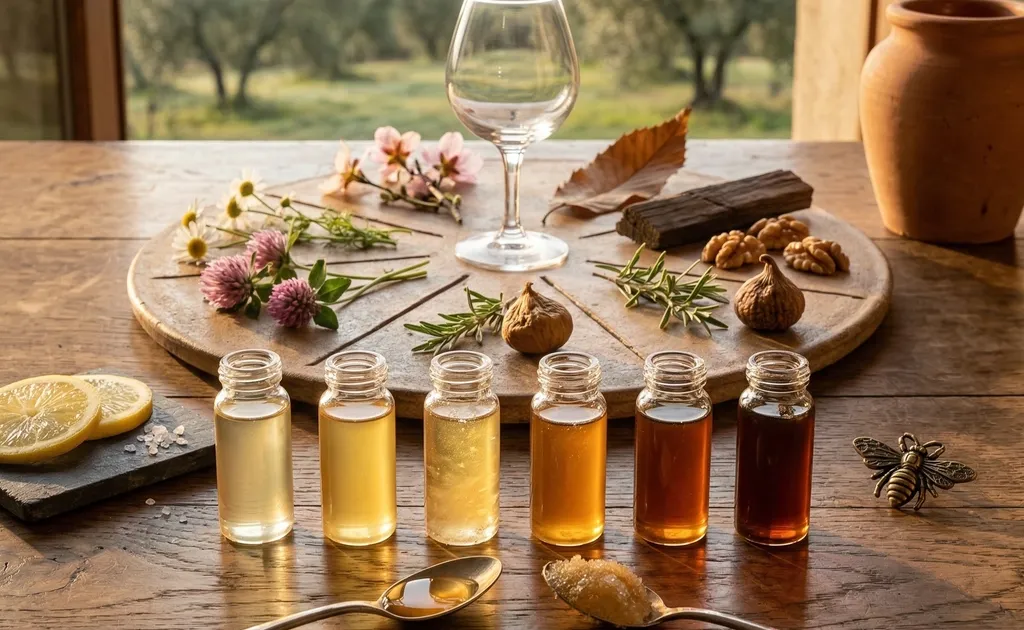
The Art of Sensory Analysis: Mapping Flavour
In the landscape of haute gastronomy, tasting is not a passive gesture, but an active biochemical and aesthetic investigation. Approaching the sensory analysis of a raw artisanal honey means exploring a complex architecture of aromas, colours, and textures, treating the product with the same analytical rigour reserved for a wine Grand Cru or a batch of Specialty Coffee.
Introduction to the Haute Sommellerie of Honey
Natural honey, cold-extracted and unmicrofiltered, presents itself as a living biological archive. The development of a genuine honey sommellerie has allowed for the scientific codification of what was once relegated to mere subjective perception.
The evolution of tasting: from mass-market product to artisanal Cru
For decades, the food industry has reduced honey to an anonymous sweetener, standardised in colour and flavour through violent pasteurisation processes and the blending of batches from heterogeneous origins. Haute sommellerie emerged precisely to dismantle this paradigm, re-educating the palate to recognise and appreciate the extreme variability of the terroir.
A luxury artisanal honey is the liquid expression of a specific pedoclimate. Sensory analysis allows us to isolate and champion these differences, restoring dignity to precision beekeeping and transforming the tasting into a journey through intact ecosystems, where the local botany manifests with absolute organoleptic purity.
Why sensory analysis is the pillar of quality
Without adequate sensory training, it is impossible to distinguish a botanical masterpiece from a compromised product. Visual, olfactory, and gustatory analysis represents the first and most formidable shield against adulteration. A trained palate can perceive the absence of thermolabile enzymes, premature oxidation, or an anomalous spike in the HMF Index (Hydroxymethylfurfural) caused by storage at unsuitable temperatures.
In this context, mastery of analytical tools such as the Pfund Scale and the Aroma Wheel becomes essential for any hospitality professional or sophisticated enthusiast wishing to decode nature’s secret language.
Visual Evaluation: Beyond Colour
The initial contact with an apiary product is always visual. Even before the glass is brought to the nose, the honey’s appearance offers crucial indications regarding its botanical origin, its chemical purity, and the processing method employed.
What is the Pfund Scale and how is the colour of honey measured?
The Pfund Scale is an international optical instrument that classifies the colour of honey by measuring light absorbance through an amber glass prism. The values, expressed in millimetres from 0 to 140, determine the exact chromatic gradation of the product, ranging from water-white to dark amber.
This measurement system, universally recognised by tasting panels, untethers the visual description from personal interpretation, anchoring it to unequivocal technical data. The colour of a honey is strictly dependent on the nectar’s mineral composition, the altitude of the foraging, and the pedological characteristics of the soil.
- A Pfund score below 8 mm indicates a honey classified as water-white (transparent), typical of certain exceptionally pure vintages of Acacia or Asphodel.
- Intermediate values (from 34 to 85 mm) encompass shades from extra-light amber to light amber, the undisputed realms of spring Wildflower or Sulla honey.
- Scores exceeding 114 mm define dark, amber, and sombre honeys, an expression of high electrical conductivity and a massive presence of mineral salts and polyphenols. In Lazio, this category is superbly represented by Chestnut honey from the Monti Cimini and rare Forest Honeydews.
Reading purity: Natural crystallisation vs. visual defects
A thorough visual examination does not stop at the hue alone. For the expert taster, the physical state of the sugar matrix recounts the entire post-extraction history of the product.
Absolute, perpetual clarity is almost always an indicator of industrial intervention. A honey of excellence, rigorously raw, develops an opalescent structure over time due to the precipitation of glucose crystals. Crystallisation is not a defect, but the signature of authenticity. The size of the crystals, the homogeneity of the mass, and the presence of slight whitish “marbling” or frosting against the walls of the glass jar (due to the honey shrinking at low temperatures) certify the absence of pasteurisation.
Conversely, genuine and alarming visual defects include a stark separation into two phases (liquid on the surface and solid at the bottom), a symptom of faulty crystallisation or storage at unstable temperatures, and an excessive presence of persistent foam, which could suggest fermentation processes triggered by osmophilic yeasts.
The impact of moisture on visual brilliance
Natural moisture plays a fundamental role in light refraction and, consequently, in the brilliance of the honey. Optimal moisture, guaranteed by the bees during the capping phase of the honeycomb and maintained below 17.5%, bestows a silky, vibrant luminosity upon the product. Should the moisture be excessive, the honey would appear opaque, disjointed, and optically flat, foreshadowing a lack of body in the subsequent palatal phase.
Olfactory Evaluation: Decoding Volatile Notes
The complexity of an apiary Grand Cru reveals itself powerfully during the olfactory examination. Responsible for the honey’s bouquet are the volatile organic compounds (VOCs), an infinitesimal chemical fraction (often less than 0.001% of the total weight) yet possessing extraordinary elegance and volatility.
How is the Aroma Wheel used to classify the scent of honey?
The Aroma Wheel is utilised by olfactorily mapping the volatile compounds, starting from the centre of the diagram—which identifies the aromatic macro-families—and moving progressively towards the outer rings to isolate specific descriptors, thus providing a standardised and universal vocabulary.
Created by leading research institutes on the sensory analysis of honey, the Aroma Wheel allows the sommelier to translate ethereal sensations into objective data. By smelling the sample—first statically and then by smearing it along the walls of the glass to increase the surface area in contact with oxygen—the taster isolates the dominant family before focusing on the accessory nuances.
This decoding is essential, as every floral typology and every terroir imprints a precise volatile spectrum, generated by chains of aldehydes, ketones, and esters.
The Honey Aroma Wheel: Primary Olfactory Families
Olfactory taxonomy is divided into macro-groups that guide the botanical and geographical identification of the batch under examination.
Floral and Fruity Notes (e.g., Spring honeys of Lazio)
This macro-category embraces ethereal and delicate scents, often linked to early blooms in intact ecosystems.
- Floral: Can manifest as notes of fresh white flowers, rose petals, pale chamomile, or orange blossom. The great Wildflower honeys of the Roman Campagna and the Appian Way Regional Park frequently emanate these vibrations, featuring exceptionally elegant vanilla and powdery peaks, the fruit of late April’s extraordinary biodiversity.
- Fruity: Includes evocations of white-fleshed fruit, dehydrated apricot, fresh citrus, or jam. The freshness of these notes is an unequivocal marker of the product’s integrity; the slightest thermal stress would “cook” these volatile perceptions, flattening them irretrievably.
Vegetal, Warm, and Toasted Notes (e.g., Chestnut Honeys)
This section of the Aroma Wheel houses more robust, dense, and structured scents, typical of summer blooms and tall trees.
- Vegetal/Herbaceous: Outlines fragrances of mown grass, dry hay, Mediterranean scrub, or tomato leaves.
- Warm/Toasted and Woody: Here reside the notes of caramel, resin, wet wood, leather, blond tobacco, and undergrowth. The Eucalyptus honey of the Agro Pontino distinguishes itself in this area with aromas of dried mushrooms, helichrysum, and salted liquorice. The majestic Chestnut of the Tuscia Viterbese pushes these descriptors to the very limits of the phenolic, delivering a potent and animalistic olfactory impact, both pungent and noble.
Olfactory defects: Recognising anomalous fermentations
The olfactory examination is the supreme judge of proper storage. Any acetic note, scent of wet brewer’s yeast, or worse, cooked and stale aromas, denounces a vertical collapse in quality. Inadequate storage or the presence of moisture exceeding limit parameters triggers the proliferation of yeasts that alter the sugar matrix, producing carbon dioxide and alcohol, thereby irreparably destroying the gastronomic value of the product.
Gustatory and Tactile Evaluation
Bringing the honey into the mouth marks the transition from volatile analysis to material exploration. The human tongue, raising the sample to 37°C, allows the crystals to melt and unleashes the power of retronasal olfaction, where the Intense Aromatic Persistence (PAI) is evaluated.
The delicate balance between Sweetness, Acidity, and Bitterness
Honey is not monolithically sweet. The apparent dominance of carbohydrates is balanced by an acidic profile essential for the product’s verticality. The pH of raw honey fluctuates between 3.4 and 6.1, governed by gluconic acid, which is produced through the activity of the glucose oxidase enzyme. This acidity, perceivable on the sides of the tongue, acts like a chemical scalpel: it cleaves through the pastiness of the sugars and cleanses the papillae, preventing the bite from becoming cloying.
Bitterness, perceived at the back of the tongue, is conversely a precious rarity, imparted by specific tannins and glycosides present in Chestnut or Strawberry Tree (Corbezzolo) honeys. It is an elegant, persistent bitterness that, within the landscape of Lazio, finds expressions of incredible gastronomic vocation for pairings with extra-mature cheeses.
What role does the Fructose/Glucose ratio play in the palatal sensation?
The chemical ratio between fructose and glucose dictates the rate of solubility and the physical structure of the honey on the palate. A predominance of fructose confers an immediate, sharp sweetening sensation whilst keeping the honey liquid, whereas a majority of glucose structures the product into crystals, requiring prolonged mechanical melting in the oral cavity.
Fructose boasts a sweetening power roughly 1.7 times greater than that of sucrose. A nectar with a high fructose content (like Acacia or Chestnut) will attack the tip of the tongue with a rapid, syrupy, and immediate sweetness. Conversely, rapidly crystallising honeys release their sweetness with a delay, compelling the taster to chew attentively and ensuring a tactile spreadability that elevates the tasting experience.
Tactile Analysis: Granularity, meltability, and pastiness
The tactile examination classifies the size and behaviour of the crystals. Granulometry can be fine and imperceptible (the so-called “fondant-like” consistency, highly sought after in haute cuisine for glazes and cold preparations), or coarse and crumbly, capable of creating an unexpected crunch when paired with fresh ricotta. Pastiness and adhesiveness evaluate how much the liquid honey clings to the oral mucosa before diluting, directly indicating the degree of density and the extractive richness of the original nectar.
How to Conduct a Professional Tasting at Home
Organising a sensory analysis session demands method and respect for the delicate chemical dynamics of the apiary product. An environment free from intrusive odours and proper lighting are indispensable prerequisites.
What tools and temperatures are necessary for a proper honey tasting?
A technical honey tasting requires balloon glass goblets (similar to those used for spirits) or white ceramic spoons, useful for chromatic analysis, whilst strictly maintaining the sample at a serving temperature between 18 and 22°C so as not to compromise its volatile profile.
Using small goblets allows the aromas to concentrate upwards, maximising the efficacy of the orthonasal examination. Alternatively, white ceramic spatulas do not alter the tactile perception and offer a perfect background for reading the Pfund degree by contrast. Honey must never come into contact with low-grade steel or oxidisable metals that could leach metal ions, thereby distorting its flavour.
Cleansing the palate between samples
The analysis of supersaturated matrices rapidly exhausts the taste receptors. Between one tasting and the next (it is advisable not to exceed 4-5 samples per session), the palate requires a chemical and mechanical reset. Professionals utilise wedges of green apple (whose malic acidity and mechanical crunchiness remove waxy and sugary residues) accompanied by sips of still mineral water at room temperature. Salted breads, aromatic crackers, or alcoholic beverages must be absolutely avoided during the purely analytical phase, in order not to overwrite the fragile aromatic trace of the volatile organic compounds (VOCs) being evaluated.
Conclusion: The art of listening to the Terroir through taste
The rigorous application of sensory analysis transforms the consumption of honey from a dietary habit into an act of profound gastronomic awareness. Refining one’s senses through the Pfund Scale and the Aroma Wheel allows for the unveiling of an ecosystem’s deep identity, translated into nectar by the ceaseless work of the bees.
In decoding the summer wildflowers or the dense chestnut honeys of Lazio, the taster is not simply evaluating a natural sweetener, but paying homage to a botanical Grand Cru, safeguarding and celebrating a luxury product whose true value resides in the pristine purity of its native terroir.