Melissopalynology for Identifying Lazio's Pollen
Discover melissopalynology, the science of studying pollen grains to intimately understand the honey of Lazio.
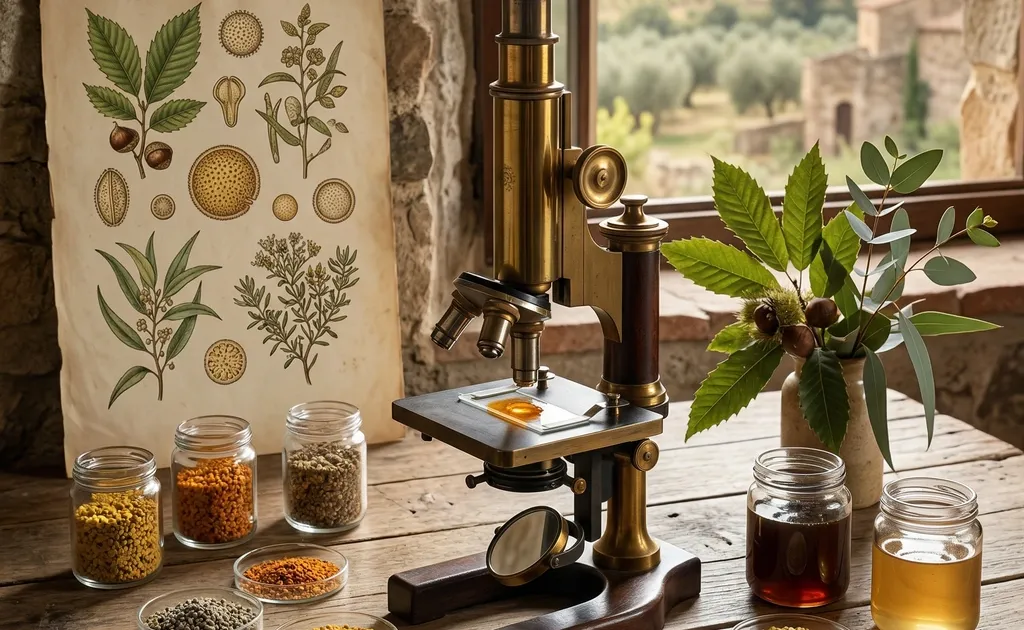
The Microscopic Identity Card of Honey
In the universe of haute gastronomy, the narrative of terroir cannot rely solely on sensory perceptions or the literary allure of a landscape. When a luxury artisanal product—such as a raw honey originating from the biodiversity oases of Lazio—is presented in haute cuisine, its origin must be proven through irrefutable scientific rigour. The discipline that elevates honey from a mere sweetener to a veritable, readable, and certifiable botanical document is melissopalynology.
What is melissopalynology and what are its biological principles?
Melissopalynology is the branch of botany that studies the pollen grains and spores contained in honey. Its biological principle is based on the microscopic identification of these sediments to pinpoint the exact geographical and botanical origin of the apiary product.
Delving into the foundations of this fascinating science, the etymology itself reveals its mission: from the Greek melissa (bee), palyno (to sprinkle, dust), and logos (study). During the ceaseless activity of foraging, the scout bee delves into the corollas to sip the sugary nectar. In this mechanical process, the microscopic pollen grains (the male gametophytes of the plant) detach from the anthers and inadvertently fall into the nectar droplet or become entangled in the insect’s dense electrostatic pubescence, eventually being stored in the hexagonal cells of the honeycomb.
The biological principle that renders this analysis infallible resides in the exine, the outer wall of the pollen grain. This membrane, composed of sporopollenin, is one of the most resilient organic polymers in nature: it does not degrade over time, it resists digestive enzymes and the acidity of the honey, keeping its complex three-dimensional architecture intact—a structure of grooves, pores, and geometric reticulations that vary from species to species like a true botanical fingerprint.
Why pollen is the “inimitable signature” of Terroir
In the global agri-food landscape, the industry utilises ultra-high-pressure filtration techniques to deliberately remove every trace of pollen from commercial honey, resulting in a perpetually transparent and, crucially, entirely anonymous liquid. This process erases the memory of the product, rendering it untraceable.
Conversely, in artisanal apiculture dedicated to excellence, honey is simply cold-extracted via centrifugal force and naturally settled. This exceedingly delicate process, which preserves the HMF Index and the enzymatic profile intact, keeps the entire insoluble fraction of the nectar in suspension. These microscopic sediments constitute the “inimitable signature” of the terroir. Through them, a jar of honey becomes an ecological core sample, an ultra-high-resolution liquid photograph testifying not only to the primary plant that provided the nectar, but to the entire shrub and floral ecosystem in which the hive was immersed.
The Analytical Process in the Laboratory
To translate this microscopic treasure into a certificate of authenticity, laboratories specialising in sensory analysis and quality control apply a rigorous physicochemical protocol.
From sample centrifugation to microscopic observation
Extracting pollen for analytical examination demands millimetric precision. A representative sample of honey (usually 10 grams) is taken and dissolved in lukewarm distilled water (never exceeding 40°C so as not to alter the organic structures). The resulting solution undergoes repeated cycles of high-speed centrifugation. This procedure separates the liquid sugar matrix from the solid sediment, which settles at the bottom of the test tube.
The sediment or pellet, concentrated and washed, is extracted with a micropipette, placed upon a microscope slide, stained with specific substances (such as basic fuchsine) to highlight the sculpturing of the exine, and finally sealed. At this point, the palynologist intervenes using a transmission optical microscope (with magnifications ranging from 400x to 1000x), commencing the meticulous morphological classification and the counting of every single grain present in the visual field.
The pollen spectrum: Distinguishing dominant, accompanying, and isolated pollen
The result of the microscopic count is not a simple list, but a hierarchical structuring of percentage frequencies, defined as the pollen spectrum. This spectrum decrees the sales denomination of the honey and confirms its identity:
- Dominant Pollen (> 45%): Defines the primary botanical origin. For a honey to boast a monofloral designation (e.g., Eucalyptus Honey), the pollen of that specific species must exceed a certain percentage threshold. (Note: exceptions exist, such as Chestnut, which is “over-represented”, or Acacia, which is “under-represented”, with legal thresholds adjusted to their natural pollen production).
- Accompanying Pollen (16% - 45%): Reveals the secondary yet abundant blooms present in the bees’ flight area during the main nectar secretion. It adds complexity and nuance to the volatile organic compounds (VOCs) of the finished product.
- Minor or Isolated Pollen (3% - 15%): Often consisting of spontaneous undergrowth blooms or pioneer plants.
- Trace Pollen (< 3%): These grains, seemingly insignificant, are in reality the most potent geographical markers, as they frequently belong to rare and localised endemics.
How does melissopalynology allow for the unmasking of a geographically counterfeited honey?
Melissopalynology unmasks frauds by detecting, under the microscope, grains of plant species incompatible with the declared geographical area. The presence of exotic pollens or the absence of endemic markers unequivocally proves the foreign origin or the fraudulent blending of the analysed batch.
In the era of globalised supply chains, the luxury market must defend itself against increasingly sophisticated adulterations. If a jar fraudulently marketed as “Appian Way Wildflower Honey” is subjected to palynological analysis, the microscope does not lie. Should the operator identify grains of Hevea brasiliensis (the South American rubber tree) or pollens of Eucalyptus species exclusive to the Asian continent, the counterfeit would be instantly unveiled, providing the legal basis for the seizure of the batch. Similarly, if a presumed Lazio honey were found to be completely devoid of the accompanying pollens typical of the Mediterranean scrub, it would constitute proof of blending with ultra-filtered industrial honeys of dubious provenance.
The Botanical Fingerprint of Lazio
Positioning a honey as a Grand Cru requires an encyclopaedic knowledge of the territory that generated it. The Lazio region possesses an extraordinary geomorphological diversity: from volcanic reliefs to caldera lakes, down to the long, sandy coastal strips, every ecosystem produces a nectar with an inimitable microscopic identity.
Endemisms and native species of the Lazio region
The richness of the Lazio pollen spectrum resides in its endemisms and the density of its spontaneous vegetation. Beyond agricultural blooms, bees forage on wild plants that serve as a guarantee of provenance. The joint presence of pollens from Tree Heath (Erica arborea), Asphodel (Asphodelus microcarpus), Sulla (Hedysarum coronarium), and various species of rockrose and wild orchids, draws a highly precise geographical perimeter, unequivocally situating the apiary within Central Italy and, in particular, within the protected oases of Lazio.
The signature of the Monti Cimini: Pollen spectra of Chestnut and Undergrowth
The volcanic districts of the Tuscia Viterbese, and in particular the centuries-old woodlands of the Monti Cimini, are the sanctuary of Castanea sativa. Lazio Chestnut honey is a gastronomic monument, renowned for its dark amber colour, its permanence in a liquid state (thanks to a favourable ratio leaning towards fructose), and its phenolic and tannic olfactory impact.
Under the microscope, the pollen spectrum of this Cru is unmistakable. Chestnut pollen, being over-represented (the plant produces enormous quantities that fall abundantly into the nectar), presents itself as small, smooth, and elliptical grains, frequently exceeding 90% of the total count. But the true “signature” of the Monti Cimini resides in the minor pollens: the simultaneous presence of grains of Bramble (Rubus formidanus), Ivy (Hedera helix), and Clematis certifies that the nectar was processed in the humid, mineral microclimate of the volcanic Lazio undergrowth, distinguishing it from alpine or Apennine chestnut honeys of other regions.
The signature of the Agro Pontino and the Coastline: Eucalyptus and Mediterranean Scrub
Moving south, into the complex agrarian architecture of the Agro Pontino and the Tyrrhenian coast, the botanical story changes radically. Here, the monumental windbreaks planted during the historic land reclamations dominate the summer nectar-bearing landscape. Lazio Eucalyptus Honey is a jewel of sapidity, boasting mature balsamic notes of dried mushrooms, helichrysum, and liquorice.
Beneath the objective lens of the microscope, the pollen of Eucalyptus camaldulensis reveals itself with a characteristic triangular shape featuring three pores (isopolar, tricolporate). For the designation “Lazio Eucalyptus Honey” to be certified at a premium level, melissopalynological analysis is not satisfied with the dominant species alone, but eagerly seeks the framing of the coastal Mediterranean scrub. Finding associated pollens of Mastic tree (Pistacia lentiscus), Myrtle (Myrtus communis), and Phillyrea is tantamount to reading the GPS coordinates of an apiary positioned a few kilometres from the sea, lapped by the marine aerosol that endows the nectar with its inimitable electrical conductivity and sapidity.
Beyond the Species: The Vintage and Climatic Conditions
Haute sommellerie does not merely evaluate space; it also interprets time. As is the case with grand vineyards, every beekeeping vintage possesses an unrepeatable climatic course that alters the availability of nectars and, consequently, the microscopic structure of the sediment.
How the climate influences pollen percentages year upon year
Climate change and the extremisation of weather events alter the architecture of the harvest. If a spring season is particularly rainy during the flowering of a specific plant, the pollen (which is washed away from the corollas) will be under-represented in the final honey compared to the historical standards of that area, even while the aromatic base of the nectar remains intact.
Conversely, drought-stricken summers that induce water stress in tall trees will drive bees to intensify their foraging on more resilient, spontaneous herbaceous species. The expert palynologist reads these climatic variations by analysing the percentage fluctuations of the accompanying pollens, providing the taster with a scientific narrative of the seasonal meteorological trends captured within the jar.
The challenge of obtaining pure monofloral honeys in Lazio
The extreme richness and fragmentation of the Lazio pedoclimate, where Mediterranean scrub, pastures, olive groves, and coppice woods overlap in confined spaces, makes the production of a monofloral honey of absolute botanical purity a titanic challenge.
This apparent technical difficulty translates, in reality, into the region’s greatest added value. It is precisely this impossibility of completely isolating a single bloom that guarantees every Lazio monofloral will always possess a layered and complex aromatic bouquet, never banal or monotonous. This very ecological richness profoundly ennobles the concept of Wildflower (Millefiori) honey, transforming it not into a waste product (as it is frequently perceived in the industry), but into the most choral and unrepeatable expression of Roman and Lazio seasonal biodiversity.
The Added Value for Haute Sommellerie
The introduction of laboratory reports into the tasting experience represents the most advanced frontier of haute cuisine and conscious consumption.
Certifying the origin to justify the product’s prestige
In the luxury food sector, price is justified exclusively by scarcity, purity, and documentation of authenticity. Accompanying an artisanal Lazio honey Cru with its melissopalynological datasheet means instantaneously elevating its positioning. The premium consumer or the Michelin-starred chef is no longer merely purchasing an aromatic sweetener, but a guaranteed archive of biodiversity. Knowing that the honey destined to glaze a fillet or accompany a Pecorino Romano DOP boasts a low HMF Index, active enzymes like diastase, and a certified pollen spectrum mapping its exact woodland origin, is the ultimate expression of contemporary luxury.
Narrating an agricultural landscape through laboratory data
The modern Sommelier utilises the data from microscopic analysis as the sheet music for their narrative. Bringing the dish to the table, the description is not limited to the aesthetics of the product or its crystallisation; it becomes an immersive journey. Through the citation of the accompanying pollens unveiled by the analysis, the narrator transports the diner directly into the ecosystem: the wind through the chestnut branches, the heat of the summer Mediterranean scrub, the mineral volcanic soil. Science ceases to be a dry discipline and becomes the engine of emotional storytelling, grounded in the irrefutable truth of the terroir.
Conclusion: Science at the service of territorial authenticity
Melissopalynology is the supreme court of apiary purity. In a market constantly threatened by homogenisation and sophistication, the ability to read the microscopic architecture of pollen grains represents the highest form of protection for honey of excellence.
Championing a Lazio honey through the lens of a microscope means forging a pact of absolute loyalty with the consumer, defending the meticulous labour of local beekeepers, and celebrating, with both rigour and poetry, the invisible and inimitable footprint that nature imprints upon every single drop of its most precious product.