Honey Enzymes: Diastase in Raw Honey
What is the diastase index? A biochemical guide to the enzymes in raw honey to recognise an intact, unpasteurised, and ultra-premium product.
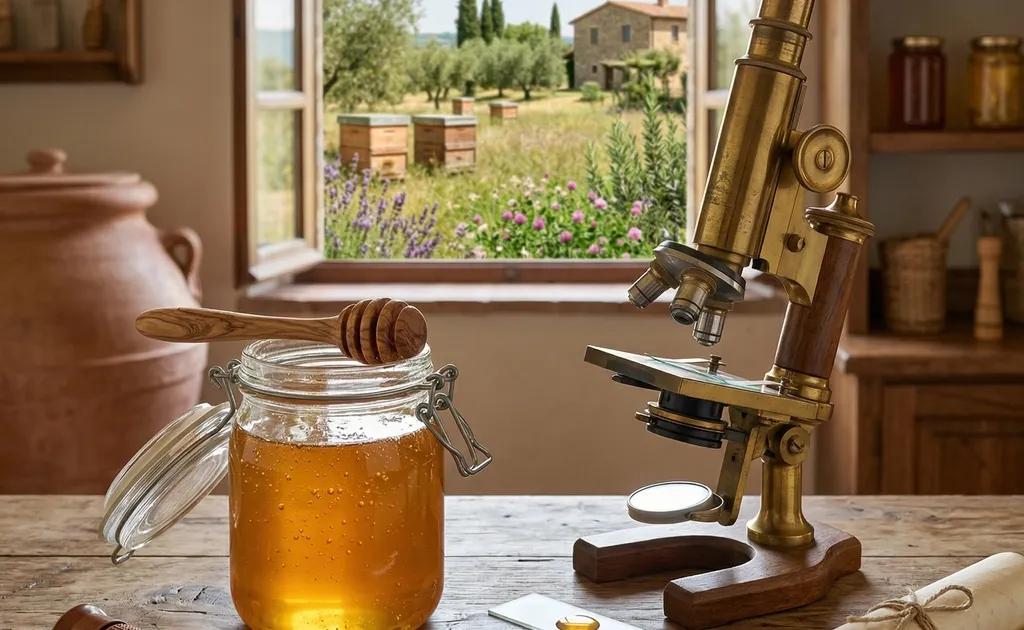
Honey Enzymes: The Living Architecture of Raw Honey
In the lexicon of haute gastronomy, the term “honey” is frequently reductive unless accompanied by a profound analysis of its composition. An apiary Grand Cru, cold-extracted and untouched by industrial processes, is not a mere inert sugar solution, but rather a complex, living biochemical matrix in constant evolution. The beating heart of this vitality is represented by its enzymatic heritage. Understanding the role of enzymes means holding the key to distinguishing a commercial sweetener from a luxury product, wherein the terroir of Lazio expresses itself in all its pristine purity.
The Enzymatic Complex: The Living Soul of Honey
Enzymes are protein macromolecules that act as biological catalysts, triggering and accelerating specific chemical reactions. In honey, they represent the unequivocal signature of the insect’s labour upon the plant’s nectar.
From nectar to honey: The biochemical labour of Apis mellifera
Nectar, as secreted by flowers, is essentially a dilute aqueous solution, rich in sucrose and highly susceptible to rapid natural fermentation. For this ephemeral substance to be transformed into honey—a shelf-stable foodstuff—a titanic transformative intervention by Apis mellifera is required.
During the foraging process and the subsequent droplet-to-droplet transfer (trophallaxis) within the hive, the bees enrich the nectar with specific secretions from their hypopharyngeal and salivary glands. This microscopic inoculation of enzymes sets off a chain of reactions that radically alters the molecular structure of the carbohydrates and the pH of the solution. It is a miracle of natural bioengineering that transforms a perishable raw material into a masterpiece of thermodynamic stability.
Why enzymes define the identity of “Raw” honey
In the premium market, the designation raw honey identifies a product that has fully retained this enzymatic architecture. Enzymes are exquisitely thermolabile; their complex protein structure denatures (is irreversibly destroyed) if exposed to heat.
Consequently, the massive and quantifiable presence of active enzymes in a jar of honey is the ultimate proof that the product has never been heated, pasteurised, or mishandled during the extraction, settling, and potting phases. A raw honey is a raw food in every sense, one that continues to mature, crystallise, and develop its volatile organic compounds (VOCs) thanks to the ceaseless micro-activity of its natural catalysts.
What is the diastase enzyme and how does it define the Diastase Index on the Schade Scale?
The diastase enzyme, or alpha-amylase, is a thermolabile bio-catalyst introduced into the nectar by bees. Its concentration determines the Diastase Index, measured in units on the Schade Scale. This analytical value serves as the primary indicator for assessing the absence of thermal stress and the absolute freshness of raw honey.
Delving deeper into this fundamental laboratory metric, diastase originally serves the biological function of cleaving complex starch molecules (frequently present in the form of pollen grains within the nectar) into simpler sugars such as maltose. Although starch is not the primary component of honey, diastase has established itself as the official, internationally recognised “thermometer” of quality precisely because of its acute sensitivity to external factors.
During sensory and chemical analysis, a honey sample is treated with a starch solution at a controlled temperature. The rapidity with which the enzyme hydrolyses the starch is measured via spectrophotometry, yielding a numerical value expressed in Schade Units.
European legislation: The legal minimum limit of 8 Schade units
To protect the consumer, European directives (including the recent and stringent EU Honey Directive 2026) stipulate that for a product to be legally marketed under the designation of “honey”, it must possess a Diastase Index of no less than 8 Schade units (with specific downward derogations permitted only for honeys naturally poor in enzymes, provided the HMF Index is near zero).
This limit represents the absolute threshold of survival. A supermarket industrial honey, subjected to mild pasteurisation or lengthy storage in uncooled drums, will hover perilously close to this minimum limit, presenting itself as a legally compliant but gastronomically “dead” sweetener.
The target of Haute Sommellerie: Demanding values above 15
Haute cuisine and luxury gastronomy are never satisfied with mere legal minimums. A honey that aspires to feature on a Michelin-starred tasting menu must exhibit a stellar analytical certificate.
The grand Crus of Lazio, when processed with the absolute rigour of ethical apiculture, display extraordinary diastase values. A Chestnut Honey from the Monti Cimini or a Eucalyptus Honey from the Agro Pontino, cold-extracted and stored in climate-controlled cellars at 14°C, can easily exceed 20 or 30 Schade units. This enzymatic surplus provides the chef and the sommelier with the absolute guarantee that the nectar’s aromatic architecture is pristine, vibrant, and primed to unleash its maximum palatal complexity.
What are the functions of invertase and glucose oxidase in raw honey?
Invertase hydrolyses the sucrose in the nectar, transforming it into glucose and fructose, thereby dictating the physical structure of the honey. Glucose oxidase converts glucose into gluconic acid, modulating the pH and generating hydrogen peroxide to guarantee the natural microbiological stability of the product, preventing the onset of anomalous fermentations.
If diastase is the analytical marker par excellence, invertase and glucose oxidase are the enzymes that literally construct the flavour, texture, and verticality of the finished product.
Invertase (Sucrase): The architect of the Fructose/Glucose ratio
Invertase (or alpha-glucosidase) performs the heaviest lifting within the hive. Raw nectar is dominated by sucrose, a disaccharide. Invertase cleaves this bond, liberating the two fundamental monosaccharides: fructose and glucose.
- Superior Sweetness: Fructose possesses a sweetening power vastly superior to the original sucrose, conferring upon the honey its characteristic sugary potency, capable of balancing savoury cheeses or structured meats.
- Crystallisation Dynamics: The proportion in which glucose and fructose are structured dictates the physical destiny of the honey. It is the activity of invertase that triggers the supersaturation process which will, over time, cause the glucose to precipitate into elegant crystals, creating the fascinating tactile consistencies sought by tasters (the so-called fondant-like or sandy textures).
Glucose Oxidase and natural stabilisation
The glucose oxidase enzyme plays a crucial role in the ecological stabilisation of the honeycomb. Added in massive doses by the bees during the desiccation of the nectar, this catalyst oxidises a small fraction of the newly formed glucose. The products of this reaction are twofold:
- Gluconic Acid: The primary agent responsible for the honey’s markedly acidic pH (which ranges between 3.5 and 5.5). In sensory analysis, gluconic acid is the element that cleaves through the sweetness, cleanses the palate, and brings elegance and freshness to the bite, preventing the honey from becoming cloying.
- Hydrogen Peroxide: Developed in constant micro-doses, it acts as an internal microbiological stabiliser. Before the natural moisture drops below the safe threshold of 18% (the limit beyond which osmophilic yeasts cannot proliferate), hydrogen peroxide sterilises the aqueous environment, ensuring the honey does not ferment within the cells.
Thermal sensitivity: Which enzymes perish first from heat
Every enzyme has its own specific thermal breaking point. Although legislation focuses on measuring diastase, invertase is, in reality, the most delicate enzyme of all. Its activity halves rapidly if the honey is exposed to temperatures exceeding 40°C—the exact same temperature that volatilises the precious floral aromas of a Lazio Wildflower honey. Therefore, a honey presenting a high Diastase Index but a degraded invertase profile has undoubtedly been the victim of inadequate storage or “covert” heating prior to packaging.
The Enemy of Enzymes: Industrial Pasteurisation
To fully grasp the importance of defending the enzymatic profile, one must analyse the standard practices of the mass food industry, whose logic is entirely antithetical to that of haute sommellerie.
The destruction of the biochemical heritage at 70°C
Within the mass retail market, crystallised honey is perceived by the uneducated consumer as an aesthetic flaw. To guarantee a perpetually liquid and transparent product, the industry resorts to pasteurisation. The honey is forced through heat exchangers at temperatures exceeding 70-75°C for several minutes, followed by rapid cooling and high-pressure ultra-filtration.
This thermal shock:
- Completely denatures the enzymatic proteins (Diastase and Invertase collapse).
- Permanently dissolves the glucose condensation nuclei.
- Triggers the Maillard reaction and the dehydration of sugars in an acidic environment, producing massive quantities of degraded substances. The result is an amorphous liquid, stripped of its biological soul and entirely disconnected from any territorial belonging.
How the EU Honey Directive 2026 protects cold-extraction processes
The new legal architecture introduced by the EU Honey Directive 2026 has dealt a severe blow to legalised frauds. By mandating absolute traceability and tightening the parameters on degradation, the European legislator effectively champions the artisanal producer. The use of terms such as “cold-extracted” or “raw honey” on the label is now contingent upon irrefutable laboratory tests certifying the full enzymatic vitality of the batch.
Pasteurisation vs. Natural settling: The artisanal path
In the elite apiculture practised in the oases of Lazio, extraction occurs exclusively via centrifugal force at room temperature (around 25-30°C). Subsequently, instead of filtering the honey hot and under pressure, the product is transferred into large steel settling tanks.
Through natural settling, which requires weeks of patient waiting, waxy impurities and air bubbles rise to the surface. This allows the beekeeper to skim the top and pot a pristine product, wherein the original enzymatic ecosystem remains absolutely unadulterated and ready to evolve within the glass.
Reading the Analytical Certificate: Diastase and HMF
A conscious gastronome, when purchasing a premium Cru, knows how to read and interpret laboratory data, decoding the balance between the two fundamental chemical parameters.
The inversely proportional correlation between Enzymes and HMF
The Diastase Index is never evaluated in isolation; it is always read in conjunction with the HMF Index (Hydroxymethylfurfural). HMF is an organic compound practically absent in fresh nectar, which forms exclusively through the thermal degradation of sugars in an acidic environment.
Between the two values exists an inversely proportional and implacable correlation: as thermal stress (and therefore HMF) increases, there is a corresponding, vertical collapse in diastase Schade units.
- Excellent Honey (Raw): High diastase (>15) and HMF near zero (0-5 mg/kg).
- Industrial or Old Honey: Low diastase (around 8) and high HMF (>30 mg/kg).
Physiological ageing: How enzymes degrade over time
Honey is a living food and, as such, it ages. Even the purest honey, stored in a domestic pantry at temperatures of around 20-22°C, undergoes a slow but inexorable enzymatic decline and a simultaneous, physiological increase in HMF.
Over the course of two or three years at room temperature, a luxury honey loses much of its original enzymatic energy and its most elegant aromatic fractions begin to fade. For this reason, haute cuisine applies the same storage rules to honey as it does to fine wines: storage in the dark in climate-controlled cellars at 12-14°C, temperatures capable of “freezing” the biological clock of the product and preserving its fragrance intact for years.
Honeys with naturally low diastase: The botanical exceptions
In a rigorous analysis, a specific botanical peculiarity must be highlighted. Not all nectars require the same enzymatic intervention from the bees. Blooms that offer a nectar already rich in monosaccharides necessitate a lesser addition of enzymes.
The classic example in Italy is Citrus honey (Orange, Lemon). Due to its genetic nature, a pristine, freshly extracted Citrus honey can present a naturally very low Diastase Index (between 5 and 10 Schade units). Legislation accounts for this, permitting the sale of such honeys with the limit lowered to 3 Schade units, under the strict condition that the HMF does not exceed 15 mg/kg. This proves that the low enzymatic value is a genetic factor of the flower and not the result of thermal abuse.
Conclusion: Choosing enzymatic vitality for an authentic experience
The biochemistry of raw honey is not a notion to be relegated to laboratory benches; it is the very essence of the tasting experience. Demanding and protecting the presence of intact enzymes means rejecting artifice and asserting the right to purity.
Every spoonful of a grand Lazio Wildflower Honey, with its vibrant gluconic acidity and its dynamic crystallisation governed by invertase, is a tribute to pristine biology. For the enthusiast, the sommelier, or the haute cuisine chef, choosing a Raw product with a high diastase content ultimately means forging a pact of respect with nature and indulging in an organoleptic masterpiece that is both biologically and sensorially alive.