Honey Crystallisation: Fructose and Glucose
Discover how the fructose to glucose ratio drives the crystallisation of raw honey and defines its texture on the palate in haute sommellerie.
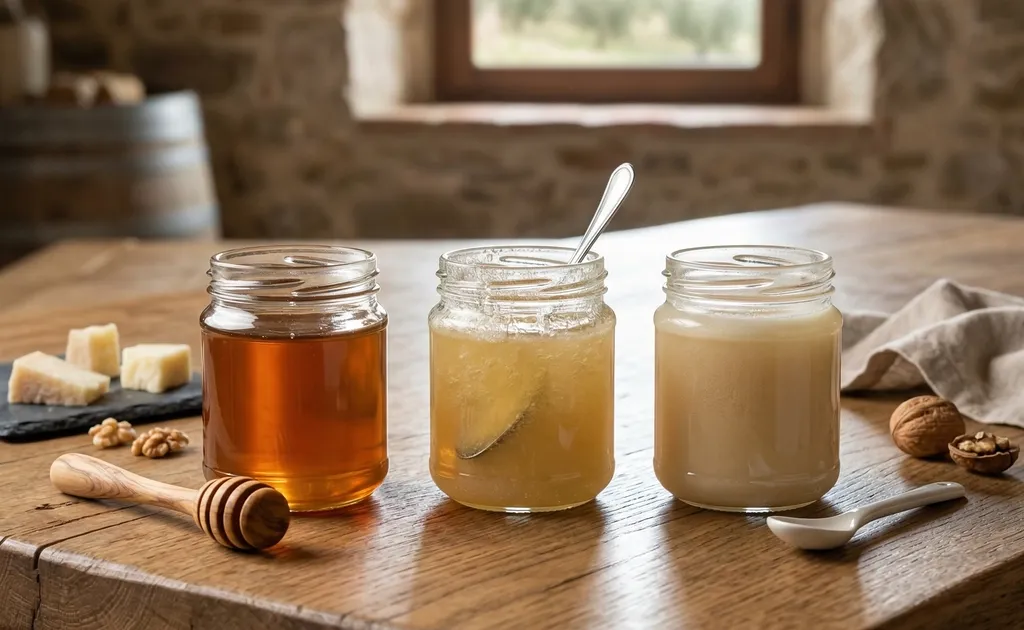
Honey Crystallisation: The Tactile Architecture of Terroir
Within the landscape of haute gastronomy, honey tasting has long surpassed the mere evaluation of sweetness to embrace a tactile and material analysis of extraordinary complexity. The physical metamorphosis from liquid to solid, known as crystallisation, is not a simple aesthetic quirk, but rather a fascinating thermodynamic phenomenon that certifies the absolute purity of an artisanal product. Understanding the biochemical equilibrium between fructose and glucose means holding the key to fully appreciating the nuances of an apiary Grand Cru from the Lazio region.
The Physics of Crystallisation: A Hallmark of Purity
The universe of raw (raw) honey is governed by fragile and delicate physicochemical balances. Cold extraction and the absence of industrial microfiltration preserve the nectar’s structural integrity, allowing it to evolve naturally across time and space.
Dispelling the myth: Crystallised honey is neither altered nor expired
For decades, the mass agri-food industry has accustomed consumers to supermarket shelves laden with perpetually liquid, brilliantly transparent honeys. This aesthetic standardisation has generated a profound cultural misunderstanding, leading many to believe that crystallisation is synonymous with deterioration, expiration, or, worse still, fraudulent adulteration with added artificial sugars.
The scientific truth, celebrated in haute sommellerie, is diametrically opposed. Crystallisation is a noble, spontaneous, and reversible physical process. Its presence is the most evident visual certificate that the product has never been subjected to pasteurisation processes (thermal shocks exceeding 70°C) aimed at artificially melting the crystals. A honey that solidifies is a biologically living food, wherein enzymes (such as diastase and invertase) operate undisturbed and the HMF Index (Hydroxymethylfurfural) remains at levels of absolute excellence.
The supersaturation of sugars in the Raw product
From a strictly chemical perspective, honey is a supersaturated aqueous solution. It contains approximately 80% dissolved sugars (primarily monosaccharides) against a natural moisture content that, in a premium product, must sit below 17.5-18%.
Under normal conditions of pressure and temperature, this quantity of water is insufficient to keep such a massive volume of carbohydrates in solution indefinitely. The matrix therefore finds itself in a thermodynamically unstable state. To regain equilibrium, the system “expels” the excess solute via the process of crystalline precipitation, transitioning from a chaotic liquid state to an ordered, solid molecular structure.
The Crucial Role of the Fructose/Glucose Ratio
The sugar profile of honey is not uniform; it varies radically depending on the botanical origin of the nectar collected by the bees. The two principal components dictate the physical destiny of the product within the jar.
How does glucose trigger the formation of crystals in honey?
Glucose triggers crystal formation due to its lower aqueous solubility compared to fructose. In a supersaturated solution like natural honey, the excess glucose spontaneously separates, aggregating around condensation nuclei to form solid reticular structures.
Delving into the specifics of this phase transition, crystals do not materialise out of thin air. For glucose to begin solidifying, it requires “nucleation seeds” or condensation nuclei. In a raw honey that has not undergone industrial microfiltration, these nuclei are represented by microscopic and invaluable suspended particles: pollen grains (fundamental for melissopalynological analysis), minuscule fragments of propolis, virgin capping wax, and tiny air bubbles incorporated during cold extraction. The richer the honey is in these natural elements, the swifter and more homogeneous the onset of crystallisation will be.
Fructose: The element that maintains the liquid matrix
Fructose acts as the exact opposite of glucose. Endowed with a vastly superior solubility in water, fructose is highly hygroscopic and tends to remain firmly in solution, retaining the surrounding moisture.
Honeys that present a high concentration of fructose are destined to retain their liquid state for months, years, or, in some cases, decades. Within Lazio’s botanical heritage, the most illustrious example is the Chestnut honey of the Monti Cimini and the Tuscia. Its imposing, fructose-driven sugar structure prevents glucose from precipitating, yielding a product with a fluid, viscous, and velvety texture, perfect for enveloping the palate and slowly releasing its powerful phenolic, tannic, and bitter notes.
How to calculate the crystallisation index from laboratory data
For haute cuisine and selectors of gastronomic excellences, predicting the physical behaviour of a Cru is paramount. Sensory and chemical analysis laboratories utilise the Fructose/Glucose (F/G) ratio or the Glucose/Water (G/W) ratio as absolute predictive indices:
- F/G Ratio > 1.3: The honey will remain liquid for exceedingly long periods (e.g., Acacia, Chestnut, Forest Honeydews).
- F/G Ratio < 1.1: Crystallisation will be rapid, massive, and compact (e.g., Dandelion, Ivy, Rapeseed, Clover).
- G/W Ratio > 2.1: The tendency for precipitation is exceptionally high; the matrix will crystallise within a few weeks of cold extraction (e.g., Eucalyptus from the Agro Pontino, Sunflower from the Roman Campagna).
These biochemical parameters do not denote the superior quality of one honey over another; they merely outline its genetic-botanical passport.
The Influence of Storage Temperature
If the botanical origin decides “whether” and “how much” a honey will crystallise, the storage temperature governs the “when” and “how”, directly influencing the architecture of the crystals.
Why does a temperature of 14°C drastically accelerate honey crystallisation?
A temperature of 14°C drastically accelerates crystallisation because it represents the ideal thermodynamic equilibrium where the molecular mobility of glucose is reduced—facilitating crystal aggregation—without the honey’s cold-induced viscosity physically halting the entire condensation process.
To explore this fascinating thermal dynamic, one must analyse the extremes. At temperatures below 10°C, crystallisation paradoxically slows down, as the honey’s viscosity increases exponentially: the matrix becomes so dense that the glucose molecules can no longer move to anchor themselves to the condensation nuclei. Conversely, once temperatures exceed 25°C, thermal energy begins to dismantle the crystalline lattices, leading them to spontaneous fusion. The band around 14°C therefore represents the thermodynamic apex of sugar aggregation, a parameter widely exploited in premium apiculture to guide the creation of exquisitely fine, spreadable textures.
Cellar vs. Pantry Temperatures: A guide for the enthusiast
Treating an artisanal Lazio honey with the same deference reserved for a vintage wine necessitates strict rules for its storage.
- The Cellar (12-15°C): This is the ideal environment if one wishes to encourage a homogeneous and compact crystallisation. A spring Wildflower from the Roman Campagna, stored at these temperatures and shielded from direct light, will develop a flawless crystalline mesh in a matter of months, preserving its ethereal volatile organic compounds (VOCs) intact.
- The Pantry (18-22°C): Slows the natural course of crystallisation. It is the ideal temperature for serving and short-term storage. Beyond 22°C, the honey begins to suffer. Prolonged storage in warm environments inevitably degrades its enzymatic architecture, triggering enzymatic browning and a dizzying spike in the HMF Index.
The impact of climate change on storage temperatures
In the context of the current climate emergency, with summer heatwaves regularly exceeding 38°C in Lazio, maintaining the integrity of the raw product is becoming a challenge. Domestic pantries and non-air-conditioned warehouses expose honey to severe stress.
An already solidified honey, subjected to anomalous summer temperatures, may undergo partial decrystallisation followed by phase separation: a liquid portion (rich in fructose and water) rises to the surface, whilst an irregular solid deposit settles at the bottom. This visual and structural defect accelerates the risk of fermentation due to osmophilic yeasts finding fertile ground in the high-moisture liquid layer. For gastronomic excellence, obsessive temperature control (a moderate cold chain) has become a categorical imperative.
Tactile Analysis on the Palate: Evaluating the Crystals
In the complex haute sommellerie of honey, the tactile examination is the moment when the sugar architecture reveals its character. The shape, size, and behaviour of the crystals in the mouth transform a simple tasting into a three-dimensional sensory experience.
Fine and fondant crystallisation: The “honey butter” effect
Certain honeys of exceptional prestige, particularly those managed with thermal mastery by the beekeeper, develop micro-crystals so infinitesimally small as to be imperceptible when the tongue sweeps across the palate. This structure is frequently termed a “fondant-like” or “honey butter” consistency. When introduced into the oral cavity, body heat (37°C) disintegrates the sugar emulsion in a fraction of a second. The melting texture coats the mouth, gradually releasing orthonasal and retronasal aromas without ever assaulting the palate. The magnificent Eucalyptus honey from the windbreaks of the Agro Pontino, when artisanally processed, expresses exactly this noble, melting pastiness, juxtaposing it with notes of salted liquorice and dried mushrooms.
Coarse and sandy crystals: Botanical and thermal causes
Not all crystallisations are fine. Specific botanical origins or storage in environments with sharp thermal fluctuations can generate macroscopic, angular crystals that are clearly distinguishable upon mastication. This “sandy” or crunchy texture is not a defect, but a rustic and sincere expression of the terroir. Coarse crystals require the mechanical intervention of the teeth, prolonging tasting times and providing a highly significant tactile contrast. These “crunchy” honeys are the secret weapon of Michelin-starred chefs for creating textural disruptions in plated desserts or atop dairy preparations.
The Sommelier’s vocabulary for describing texture
To standardise tactile evaluation, professional sommellerie has codified a specific vocabulary:
- Granularity: The measure of the geometric size of the crystals, perceived by compressing the honey between the tongue and the hard palate.
- Adhesiveness: The resistance the honey offers against detachment from the oral mucosa. Viscous, fructose-driven honeys exhibit exceedingly high adhesiveness.
- Solubility: The speed at which the honey, whether liquid or crystallised, dissolves as it mixes with saliva.
- Astringency: A tactile sensation of drying in the oral cavity, unlinked to crystal geometry but intimately connected to the high presence of natural polyphenols (classic in Chestnut honey).
Product Management in Haute Cuisine
Serving a raw, crystallised product requires profound respect for the raw material and an impeccable understanding of its physicochemical reactions during service.
How to serve a crystallised honey without altering its thermal profile
The most dramatic error committed during service is the use of microwave ovens or boiling water baths to temporarily liquefy a solid honey. This act destroys years of thermodynamic waiting and volatilises the VOCs. Haute cuisine serves crystallised honey by drawing it directly from the storage jar at room temperature (approximately 20-22°C), utilising dedicated stainless steel spatulas or mother-of-pearl and white ceramic micro-spoons, shaping small “quenelles” of the solid product to rest elegantly upon the tasting board.
Gentle decrystallisation: Strict limits to avoid compromising the HMF
Should an ultra-premium Cru absolutely need to be served in a liquid state for specific glazing requirements, the only ethically and gastronomically acceptable method is prolonged, “gentle” decrystallisation.
The jar is placed in forced-air thermostatic incubators, rigorously calibrated to a maximum temperature of 38-40°C (the same temperature as the hive during the summer peak). This slow, respectful process takes days to gradually melt the glucose bridges, guaranteeing the absolute survival of the thermolabile enzymes and preventing the stress-induced formation of hydroxymethylfurfural. Any higher temperature would dictate the immediate demotion from a Premium product to a commonplace sweetener.
Texture pairings: Crunchy crystals on soft cheeses
The supreme exaltation of crystallisation is achieved through the science of pairing via tactile contrast. The architecture of flavour plays on opposing geometries:
- Crunchy-Soft Contrast: A honey with coarse, sandy crystallisation finds its ideal stage resting upon an exceedingly fresh Roman Sheep’s Milk Ricotta or lactic coagulation cheeses. The yielding, fatty softness of the cheese is interrupted by the sugar crystals exploding beneath the teeth, while the moderate acidity of the nectar “cuts” through the lactic component.
- Melting-Hard Contrast: Honeys with a fine, buttery crystallisation, or perpetually liquid ones like Chestnut, wed beautifully with crumbly, salty, and aged dairy excellences, such as mature Pecorino Romano DOP. In this instance, the honey acts as a fluid binder, penetrating the fissures of the flaked cheese and unifying the tactile sensation, in a marriage where the liquid texture of the fructose soothes the trigeminal violence of the ageing process.
Conclusion: Appreciating the natural evolution of Terroir
Honey crystallisation is a declaration of independence from industrial standardisation. Understanding the noble chemical dance between fructose and glucose allows one to elevate a physical phenomenon into a central element of the luxury gastronomic experience.
To welcome and savour a solidified raw honey means embracing the philosophy of waiting, respecting the intact biochemical architecture of the nectar, and, above all, celebrating the magnificent and unpredictable diversity that only the grandiose ecosystem of Lazio, through the tireless work of the bees, is capable of gifting to the palate.