The Architecture of Flavour: Pairing Honey and Cheese
The scientific and sensory rules for pairing and enhancing the contrasts between raw honey and premium cheeses from Lazio.
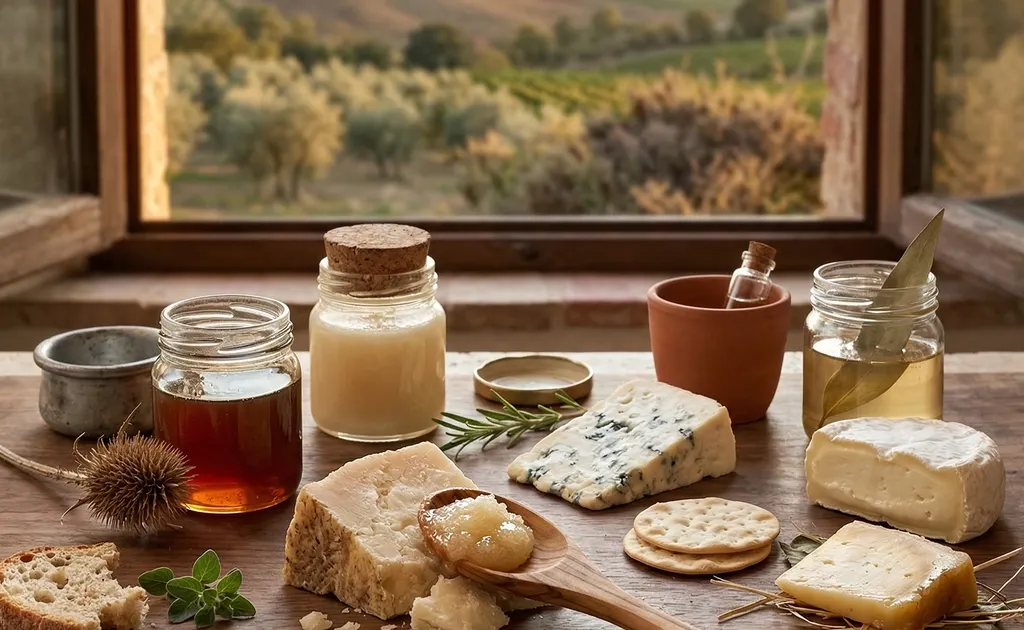
The Architecture of Flavour in Honey and Cheese Pairing
In the realm of haute cuisine and luxury gastronomy, the pairing of honey and cheese has long transcended the simple rustic cliché, elevating itself to a true sensory science. It is no longer about pouring a random sweetener over a slice of cheese, but rather orchestrating a meticulously calibrated encounter between two complex, living biochemical matrices, capable of enhancing one another through precise rules of contrast and concordance.
Which chemical reactions govern the flavour contrast between honey and cheese?
The contrast between honey and cheese is governed by the molecular interaction between the monosaccharides in the honey and the proteins and fats within the cheese. This synergy balances the high lactic sapidity and the bitterness of certain curds, creating newly formed aromatic complexes on the palate without altering the fundamental nature of the ingredients.
Examining this interaction from a sensory analysis perspective, cheese is a food dominated by sapidity, umami (resulting from protein degradation during the ageing process), and a high percentage of fat. Honey, conversely, is a fat-free, supersaturated aqueous solution, driven by simple sugars (fructose and glucose) and a significant latent acidity imparted by gluconic acid.
When these elements collide in the oral cavity at body temperature, the fat from the cheese coats the taste buds, but is immediately “cut” and cleansed by the honey’s natural acidity. Simultaneously, the excessive saltiness of the cheese is mellowed by the sugar component, which acts as a gustatory buffer. This allows the taster to perceive the floral, fruity, or balsamic nuances encapsulated in the nectar’s volatile organic compounds (VOCs).
The Rule of Intensity Concordance (Body and Persistence)
The cardinal principle of haute sommellerie applied to this pairing is the concordance of body and Intense Aromatic Persistence (PAI). The two raw materials must never overpower one another; rather, they must run on parallel tracks of intensity.
- Delicate structures: A phenomenally fresh sheep’s milk ricotta or a yielding stracchino will be annihilated by a dark, phenolic honey. They require ethereal, exceptionally pale honeys, such as a spring Wildflower or a Sulla honey, which accompany the lactic notes with delicate whispers of vanilla and white blossoms.
- Imposing structures: Long-aged cheeses, blue cheeses, or pit-aged pecorini da fossa, possessing a violent trigeminal impact and pungent aromas, demand equally structured, dark honeys. These must boast a profoundly long persistence and a substantial polyphenolic profile, such as Eucalyptus or Chestnut.
Core Principles of Haute Sommellerie Applied to Pairing
To master the tasting experience, it is essential to understand that flavour is only a fraction of the equation. Serving temperature, tactile consistency, and, above all, the integrity of the apiary product dictate the success or failure of the pairing.
How does the crystallisation of honey influence the texture of the pairing?
Crystallisation dictates the texture of the pairing by introducing a solid granulometry that contrasts beautifully with the melting pastes of the cheeses. The glucose micro-crystals stimulate the mechanical receptors of the palate, amplifying the three-dimensional perception of the bite before melting completely at the temperature of the oral cavity.
In haute gastronomy, crystallisation is an absolute virtue—a visual and tactile certificate of artisanal craftsmanship. Soft, velvety cheeses find their perfect alter ego in crystallised honeys. The friability of a raw honey creates a natural, elegant “crunch”, a density contrast that compels prolonged mastication, delaying swallowing and maximising the retronasal explosion of aromas. Conversely, honeys that remain liquid for extended periods (such as those with a high fructose content) are ideal for penetrating the fissures and granular structure of highly aged, crumbly cheeses.
The role of temperature in the marriage of flavours
No premium cheese and no artisanal honey should ever be tasted at refrigerator temperature. The cold anaesthetises the taste buds and “freezes” the aromatic molecules.
Cheese must be brought to room temperature (approximately 18-20°C) for at least an hour prior to serving. This allows the fats to soften, beginning to sweat and release the notes of melted butter, grass, or barnyard typical of raw milk. Honey, which by its nature must be stored away from heat sources and light, marries ideally with cheese at this exact temperature. It then falls to the warmth of the tongue (37°C) to melt the two structures into a single gustatory emulsion.
The importance of exclusively using raw (unpasteurised) honey
The foundation of the entire pairing collapses if an industrial honey is used. Supermarket products, subjected to violent thermal shocks (pasteurisation) to dissolve crystals and keep them perpetually liquid, are essentially dead sugar syrups.
Heat irreversibly destroys enzymes (such as diastase and invertase) and evaporates the delicate chains of aldehydes and esters that form the aromatic bouquet. Furthermore, pasteurisation drastically elevates the HMF Index (Hydroxymethylfurfural), the chemical indicator of honey deterioration. Only a raw, cold-extracted, and unmicrofiltered honey possesses the structural integrity and terroir identity required to dialogue on equal terms with the complex bacterial microflora of a raw milk cheese.
Cheese Families and Their Benchmark Honeys
Every dairy family possesses a unique sensory genetic code. Let us explore the architecture of pairing, with a particular focus on the exceptional expressions of the Lazio terroir.
Soft Cheeses and Bloomy Rinds
Included in this category are lactic coagulation cheeses, fresh tomini, or international classics like Brie and Camembert. Their primary characteristics are high moisture, a pronounced lactic sweetness, and, in the case of bloomy rinds, fungal and undergrowth notes.
The contrast with rapidly crystallising honeys
The objective here is not to mask the delicate flavour of the milk, whilst providing an element of tactile disruption. Rapidly crystallising honeys, such as Dandelion, Clover, or certain hillside Wildflowers, present a gloriously rich, fondant-like structure. The encounter between the cheese’s edible rind, its yielding paste, and the incredibly fine crystals of the honey generates an enveloping experience, where the spring aromas of the nectar illuminate the earthy notes of the yeasts (like Penicillium candidum) present on the rind.
Aged Cheeses and Pecorino (A Focus on Lazio’s Excellences)
Lazio boasts a sheep’s milk tradition of extraordinary depth. The region’s aged cheeses present a very low water content, a potent saline concentration, and intense, animalistic, and piquant aromas.
The balsamic embrace: Pecorino Romano DOP and Eucalyptus Honey
This is perhaps the region’s quintessential territorial pairing. Pecorino Romano DOP, with its pungent sapidity, crumbly grain, and powerful umami notes, requires a honey capable of standing its ground without becoming cloying. The Eucalyptus honey from the Agro Pontino is the perfect candidate. Its moderately sweet notes, leaning towards dark caramel, wet wood, and liquorice, create a “balsamic embrace” around the cheese’s saltiness. The chemical reaction between the cheese’s salt and the sugar matrix enhances the dried mushroom notes of the eucalyptus, generating a third flavour—entirely novel and profoundly Mediterranean.
The bitter contrast: Pit-aged cheeses and Strawberry Tree Honey
Pit-aged cheeses (formaggi di fossa) or those matured in caves develop extreme sensory profiles: sulphur, truffle, barnyard, and a pungency that borders on anaesthetic. To govern this impetuosity, haute gastronomy resorts to a pairing of extreme contrast: “bitter on bitter”. Exceptionally rare and phenolic honeys, such as Corbezzolo (Strawberry Tree) or the grand Chestnuts of the Monti Cimini, characterised by a strong presence of tannins and decidedly bitter, astringent finishes, manage to “tame” the cheese’s aggressive fermentations. The honey’s astringency acts as a razor, stripping the excess fat from the palate and leaving an incredibly clean mouth, perfectly primed for the next bite.
Blue Cheeses
Blue-veined cheeses (Gorgonzola, Roquefort, Stilton, Blue di pecora) are threaded with noble moulds (Penicillium roqueforti) that endow them with a peculiar internal moisture, remarkable solubility, and, crucially, an overbearing metallic and piquant streak.
Mellowing the pungency: Pairing with dense and complex honeys
In this scenario, the honey must perform a calming and structural function. The sweetness is called upon to sedate the sharp violence of the mould, whilst the tactile density must envelop the fungal spores. The ideal honeys are Forest Honeydews or very dark honeys, endowed with high electrical conductivity and an abundance of mineral salts. Their notes of malt, dried figs, dates, and resin interlock seamlessly with the complexity of the blue cheese, creating a finish reminiscent of a great passito wine or a deeply aged Port.
Common Serving Mistakes to Avoid
Meticulous attention to detail is what separates a professional tasting from a haphazard approach.
Why heating honey before serving compromises the tasting
Heating honey above 40°C irreparably disintegrates the volatile organic compounds (VOCs) and denatures the original enzymatic profile. This thermal shock abruptly spikes the HMF Index, eradicating the aromatic complexity necessary to sustain a pairing with premium raw milk cheeses.
To render a stubbornly crystallised honey servable, the only method permitted in gourmet circles is cold mechanical stirring or the use of appropriate tools (micro-spoons or butter knives to shave off flakes of honey). The use of a microwave or a boiling bain-marie is considered a veritable culinary crime, as it transforms a vintage cru into a mundane syrup.
Overloading the palate: The ideal proportions (The 3:1 Rule)
Honey is not a jam, nor is it a fruit compote. It is a pure concentrate of energy and aromas. A glaring error is to submerge the slice of cheese in honey, obliterating the dairy raw material entirely. The golden ratio dictates the “3:1 Rule”: three parts cheese to one minuscule drop (or flake) of honey. The nectar must act as a condiment, an enhancing spark, and should be positioned on a single corner of the slice. This allows the taster to appreciate the cheese in its pure state before experiencing the bilateral encounter.
Curating a Vertical Tasting Board
Creating a tasting journey means designing an impeccable sensory progression that guides the palate without exhausting it prematurely.
Aromatic progressions: Where to begin and how to conclude
The verticality of a tasting follows the universal rule of a crescendo in intensity. Serving a pit-aged blue pecorino as the first course would inhibit the taste receptors for the remainder of the session. An ideal five-step journey through the Lazio terroir could be structured thus:
- Step 1 (The Ethereal Start): Exceedingly fresh Roman sheep’s milk ricotta paired with Asphodel Honey or a pale, spring Wildflower.
- Step 2 (Lactic Coagulation/Soft Paste): Semi-aged sheep’s milk caciotta with Clover Honey (fine crystallisation).
- Step 3 (Structure and Sapidity): Medium-aged Pecorino Romano DOP accompanied by the balsamic elegance of Eucalyptus Honey.
- Step 4 (The Tannic Contrast): Cave-aged cheese or an extra-mature pecorino, cut by the bitterness of Chestnut Honey from the Monti Cimini.
- Step 5 (The Trigeminal Apotheosis): A dense, piquant blue cheese, mellowed by the malted depth of an Oak Honeydew or Corbezzolo.
Palate cleansers: Neutral breads and resetting the palate
Throughout this intense journey, the palate undergoes significant sensory stress. The honey’s gluconic acid helps mitigate the accumulation of fats, but it is not sufficient. It is imperative to ban flavoured breadsticks, salted crackers, or seasoned breads (with olives, walnuts, or onion), which would irreparably pollute the perception of the VOCs. The only permitted ally is naturally leavened sourdough bread (preferably from ancient grains), lightly toasted to provide neutral structural support, accompanied by still mineral water at room temperature.
Conclusion: Honey as an enhancer, not a mask
The scientific and reasoned pairing of honey and cheese represents one of the highest peaks of gastronomic exploration. It demands respect for natural cycles, an understanding of physicochemical dynamics, and a rigorous selection of raw materials.
Choosing artisanal raw milk cheeses and pairing them with raw, local honeys means rejecting the sensory flattening of the industry. It means understanding that true luxury resides in the invisible detail: in the vitality of a preserved enzyme, in the fleeting aroma of an indigenous pollen, and in the art of orchestrating these infinite complexities into a single, unforgettable bite.