Eucalyptus Honey: Terroir of the Agro Pontino
Explore the Eucalyptus honey of the Agro Pontino. An organoleptic and botanical analysis of this Lazio monofloral honey with its unmistakable balsamic notes.
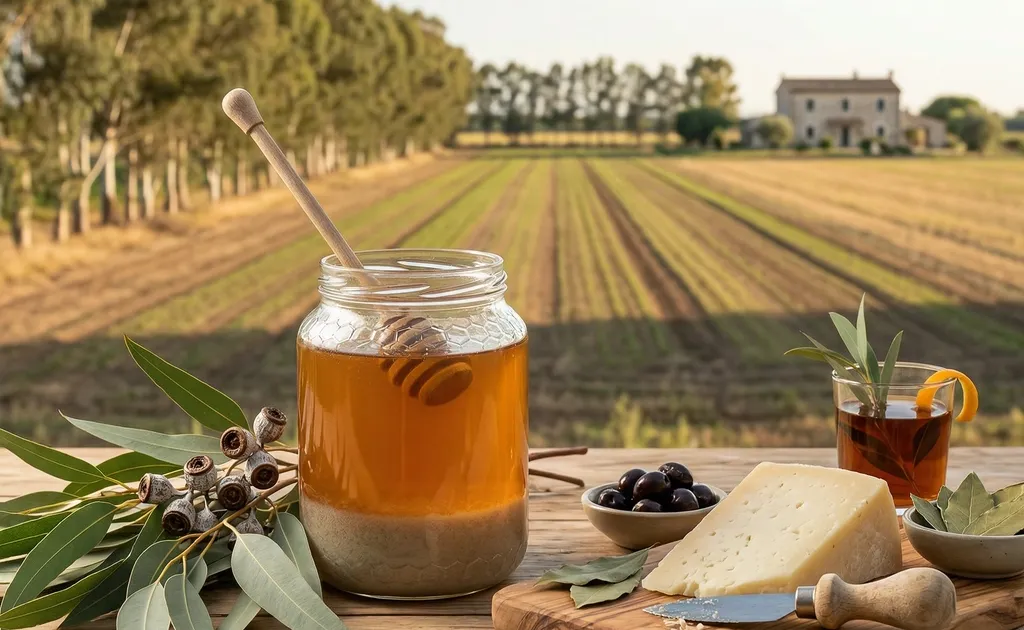
Eucalyptus Honey: The Balsamic Soul of the Agro Pontino
Within the pantheon of great Italian honeys, few offerings possess a territorial identity so intimately bound to human and geological history as the Eucalyptus honey of the Agro Pontino. Far removed from the sweet, floral profiles of spring blooms, this Lazio Grand Cru asserts itself in haute gastronomy with an austere, savoury, and profoundly complex sensory architecture. To undertake the tasting of this monofloral honey is to decode a unique coastal terroir, where the botanical engineering of the last century has fused with the tireless, meticulous labour of Apis mellifera.
The Agro Pontino: A History of Reclamation and Botany
To comprehend the biochemical matrix of this honey, it is essential to explore the pedoclimatic stage that generates it. The Pontine Plain offers a geological substrate and microclimate unparalleled in the rest of the peninsula.
The introduction of Eucalyptus camaldulensis to Lazio in the 20th century
The eucalyptus is not an indigenous species to the Mediterranean basin, but its integration into the Lazio landscape represents one of the most fascinating examples of botanical acclimatisation. During the massive, comprehensive land reclamation works of the Agro Pontino in the 1930s, millions of specimens of Eucalyptus camaldulensis (native to Australia) were planted.
This specific variety was chosen for its extraordinary water-guzzling capacity—the ability to absorb vast quantities of water from the marshy soil, aiding in the draining of malarial areas—and for its hardiness. Flourishing in sandy and clayey soils, the eucalyptus found an ideal pedoclimate on the southern coast of Lazio, mitigated by the mild currents of the Tyrrhenian Sea and lashed by salt-laden breezes.
The windbreaks of the Pontine Plain: An ecosystem for bees
Today, monumental rows of eucalyptus define the agricultural geometry of the Pontine Plain, acting as mighty windbreaks protecting premium fruit and vegetable crops. For haute apiculture, these tree-lined avenues represent an invaluable ecosystem. Bees, foraging within a radius that embraces the reclamation canals and sea breezes, find in the eucalyptus a nectar resource of primary importance during a time of year (summer) when the spontaneous Mediterranean scrub begins to suffer from the parching heat. This botanical isolation guarantees the production of an exceptionally pure nectar, which melissopalynological analyses regularly certify with dominant pollen percentages well above the legal minimum thresholds for a monofloral honey.
Landscape evolution and the protection of native flora
The nomadic and stationary apiculture that takes place in the shadow of these botanical giants has evolved into a genuine form of territorial stewardship. Choosing an artisanal Eucalyptus honey means financing the maintenance of these historic wooded strips, which today not only protect the soil from wind erosion but also offer shelter to a vast array of birdlife, integrating in perfect equilibrium with the residual native flora of the nearby Circeo National Park.
The Summer Bloom of the Eucalyptus
The harvesting of this apiary Cru demands surgical precision from beekeepers. The phenology of the eucalyptus dictates a punishing pace and a management of the colonies calibrated to the extreme temperatures of the Lazio summer.
Foraging window: Between late June and August
The bloom of Eucalyptus camaldulensis typically commences towards the end of June and extends throughout the entire month of July, edging into early August. The flowers, lacking showy petals but endowed with tufted stamens exceptionally rich in nectar, exude a warm, woody aroma. During this temporal window, the bee colonies (having reached their maximum demographic potential) operate under frequently severe climatic conditions, braving the sweltering heat to stockpile enormous volumes of nectar before the heat desiccates the fluids.
What are the effects of torrid summers on the nectar yield of Eucalyptus in Lazio?
Torrid summers drastically reduce the nectar yield of Eucalyptus in Lazio, as prolonged water stress forces the plant to halt nectar secretion to preserve vital fluids, resulting in exceedingly scarce harvests but with an extraordinary aromatic concentration.
Delving deeper into the dynamics of this climate-induced nectar famine, haute cuisine today finds itself compelled to treat Eucalyptus honey as a rarity. When temperatures consistently exceed 35-38°C and the clayey soils of the Pontino crack from drought, the tree closes its stomata and paralyses its nectaries. Nevertheless, the minuscule quantity of nectar the bees manage to extract in these drought-stricken vintages distinguishes itself by an astonishing chemical density. The sugar matrix becomes supersaturated, the concentration of polyphenols skyrockets, and the absolute absence of rain-washing gifts the sommelier a glass with exceptionally high electrical conductivity, forging extreme vintages destined for gastronomic collection.
The challenge of stationary apiculture against climate-induced drought
Faced with climate change, the master beekeepers of southern Lazio adopt rigorous ethical protocols. The absolute prohibition against resorting to emergency feeding (artificial syrups) during the harvest season guarantees that every drop extracted from the honeycombs originates exclusively from eucalyptus flowers. Furthermore, cold mechanical extraction and natural settling ensure that the HMF Index (Hydroxymethylfurfural) remains close to zero, preserving intact the exquisitely fragile enzymatic profile (such as the precious diastase) that confers vitality upon the product.
Organoleptic Profile: The Sommelier’s Examination
The technical tasting of Pontine Eucalyptus Honey immediately dismantles a deeply ingrained prejudice held by the novice consumer. Those expecting the mentholated freshness or the artificial pungency of a throat lozenge will be taken aback: true raw Eucalyptus honey does not smell of mint, but of earth, wood, and coastal sapidity.
Visual Evaluation: Light amber turning to grey-beige upon crystallisation
Subjected to visual examination, this cru initially presents with an amber hue of medium intensity on the Pfund Scale. However, as it crystallises with extreme rapidity, the form in which it arrives on the tables of haute cuisine is almost always solid. In this state, the honey loses its translucency and assumes compact, opaque chromatics that range from light hazelnut to beige, sometimes featuring elegant ash-grey nuances.
Olfactory Evaluation: The intensity of dry wood, dried mushrooms, and liquorice
On the nose, the impact is warm, closed, and moderately phenolic. The volatile organic compounds (VOCs) release an unusual and fascinating aromatic palette:
- Primary Notes: Wet wood, helichrysum, fermented hay, and a remarkably distinct perception of dried porcini mushrooms.
- Secondary Notes: Evocations of dates, barley malt, dark caramel, and a hint of sweet smokiness. This orthonasal complexity distances it from the realm of sweeteners, drawing it closer to that of spices and structured condiments.
Gustatory Evaluation: Medium sweetness, balsamic returns, and salted caramel
Bringing the honey into contact with the palatal receptors, the experience completes itself in three distinct phases:
- The Attack: The sweetness is measured, round, never cloying or invasive.
- The Mid-Palate: An intriguing savoury vein immediately takes over—a briny imprint gifted by the Tyrrhenian Sea breezes that lash the Agro Pontino—which melds with aromas of salted caramel and toffee. Gluconic acid cleanses the palate, balancing the perceived fattiness of the fondant-like consistency.
- The Finish (Retronasal Olfaction): Only after swallowing, during the deep retronasal exhalation, does the true “balsamic” nature of the product manifest: an intense, prolonged, and dry aromatic persistence of pure liquorice root and gentian.
The Typical Crystallisation of Eucalyptus
In Eucalyptus Honey, the chemical architecture manifests through one of the textures most sought after and appreciated by Michelin-starred chefs and professional tasters.
Why does Eucalyptus honey develop a compact and fondant crystallisation?
Eucalyptus honey develops a compact and fondant crystallisation due to its peculiar biochemical ratio between glucose and fructose, coupled with a low natural moisture content. This equilibrium triggers rapid aggregation into micro-crystals, yielding a velvety, melt-in-the-mouth texture on the palate.
Exploring this thermodynamic dynamic, the nectar of Eucalyptus camaldulensis boasts a pre-eminence of glucose over the more water-soluble fructose molecule. The moment the honey is cold-extracted and left to settle at cellar temperature (around 14-15°C), the supersaturation of glucose causes it to precipitate en masse around the microscopic natural condensation nuclei (pollen grains, wax traces).
The impact of the sugar ratio on solidification speed
Unlike the coarse, “sandy” crystals of other honeys, the synchronous triggering of glucose in Eucalyptus generates exquisitely fine crystals, geometrically perfect and invisible to the naked eye. This structure is described by sommeliers using the terms “fondant-like” or “honey butter”. In the mouth, the solid mass offers no mechanical resistance to the teeth, but instantaneously liquefies at the temperature of the oral cavity (37°C). This creates a silky emulsion that entirely coats the taste buds and conveys the aromas to the nasal choanae with formidable efficiency.
Pairings of Gastronomic Excellence
Due to its phenolic characteristics, its limited sugary exuberance, and its marked savoury imprint, raw Eucalyptus Honey is an ingredient of excellence for haute cuisine. It shuns banal pastry pairings to shine in bold contrasts.
The territorial marriage: Pecorino Romano DOP and balsamic notes
The pairing par excellence, rooted in the identity of the Lazio region, plays out on the cheese trolley. Serving a drop or a small quenelle alongside medium- or long-aged Pecorino Romano DOP represents the apotheosis of chemical equilibrium. The umami violence and the crystalline sapidity of the sheep’s milk cheese find a perfect counterpoint in the fondant texture of the honey. The sweetness of the nectar cushions the piquancy of the cheese, whilst the phenolic and liquorice notes of the eucalyptus wed magnificently with the animal aromas of the aged raw milk, leaving the mouth clean and aromatically fulfilled.
Culinary applications: Lacquering fatty fish and sweet-and-sour sauces
In the ateliers of haute cuisine, the dense, pasty consistency of eucalyptus is employed as a structural ingredient for savoury cooking.
- Maillard Reaction: Brushed onto the flesh of fish rich in omega-3 fatty acids, such as eel (also traditional to the coastal Pontine lakes) or salmon, prior to a pass with the blowtorch or salamander. The heat melts and caramelises the sugars, creating a crisp, brown crust infused with smoky, woody returns.
- Brown Stocks: Cold-emulsified into vinaigrettes or game stocks, it yields tactile thickness (thanks to the micro-crystals) and a gustatory three-dimensionality akin to that of an aged soy sauce or traditional balsamic vinegar.
Cold infusions: Enhancing smoky black teas
In the ritual of the high tea room, Eucalyptus Honey is the sweetener of choice for grand, oxidised, and smoked black teas. The absolute error to avoid is dissolving it in boiling water: the thermal shock would instantaneously obliterate the exquisitely delicate enzymes such as invertase and spike the Hydroxymethylfurfural. The correct technique involves the “Russian-style” tasting: a minimal quantity of honey, taken with a mother-of-pearl spoon, is placed upon the tongue. One then sips the tea (for example, a Lapsang Souchong or a heavily bergamot-scented Earl Grey). The tannins of the infusion bind with the salted caramel of the honey directly on the palate, elevating the liquorice in a retronasal explosion of rare elegance.
Conclusion: Eucalyptus as the unmistakable signature of the southern Pontino
The Eucalyptus Honey of the Agro Pontino is far more than a mere botanical variant; it is the crystallised identity of a landscape wrested from the marshes and dedicated to premium agriculture.
For haute sommellerie and the cosmopolitan consumer, to choose, to cellar at 14°C, and to taste this Grand Cru raw means holding the key to a unique sensory world. It is a honey that does not whisper, but firmly declares its origins: the sea, the wood, the savoury breeze, and the implacable Lazio summer, forever encased within the opaque gold of its magnificent, perfect crystallisation.