Climate Change and its Impact on 2026 Floral Blooms
The impact of climate change on floral blooms in the Lazio region in 2026.
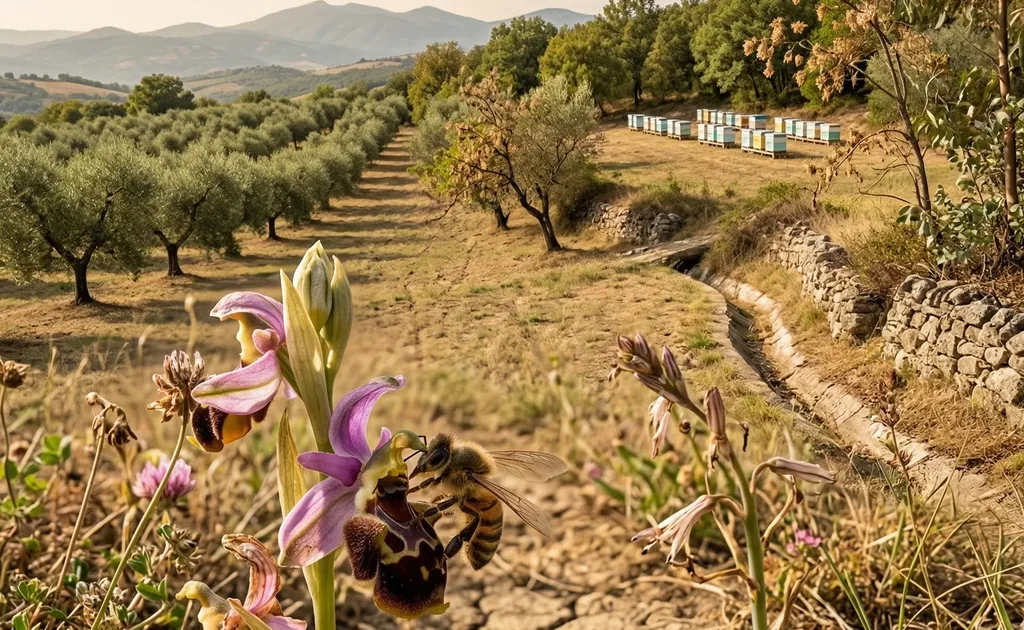
The Nectar Crisis: Climate and the Evolution of Terroir
In the world of haute gastronomy, the vintage of production tells the unrepeatable story of a territory and its meteorological conditions. In 2026, climate change has definitively transformed the geography of nectar, imposing unprecedented challenges upon luxury apiculture. Understanding the impact of these dynamics on the blooms of Lazio means delving into the biochemistry of plant survival and the bees’ ceaseless effort to adapt.
The New Climate and the Nectar Crisis
The Lazio ecosystem, historically characterised by a distinct and predictable seasonality, is now facing an extremisation of weather events. This upheaval directly strikes the most delicate link in the food and production chain: the interaction between plant and pollinating insect.
Winter thermal anomalies and the premature awakening of colonies
The biological architecture of Apis mellifera dictates a period of winter rest (the winter cluster), during which the queen halts oviposition and the colony slowly consumes honey stores to thermoregulate. However, the winter thermal anomalies recorded in 2026, with daytime temperatures consistently exceeding 15°C as early as January and February, induced a severe phenological short-circuit.
Deceived by the warmth, the bees prematurely interrupt their resting phase. The queen resumes egg-laying, triggering a dramatic surge in the colony’s energy and protein (pollen) requirements. Unfortunately, this awakening does not correspond to an adequate availability of blooms in the landscape. Scout bees expend enormous quantities of energy flying fruitlessly across a still-barren territory, causing the colony to rapidly deplete its vital stores well before the arrival of true spring.
Late April frosts: The tragedy of a false start
The second, devastating blow dealt by climatic alterations manifests through sudden waves of late frost. Plants fundamental to the ecosystem and haute gastronomy, triggered by mild winters, prematurely undergo budding and the opening of floral buttons.
When blasts of Arctic air intrude between late March and early April, the open flowers, rich in water and sap, are literally “burnt” by the cold. The necrosis of floral tissues destroys the nectar glands. This phenomenon does not merely erase the prospect of a luxury monofloral honey harvest; it deprives the colony (now at the apex of its demographic expansion) of the sustenance required for survival.
What are the effects of summer drought on the nectar secretion of flowers?
Summer drought and prolonged heatwaves induce severe water stress in plants, halting the activity of nectaries. To preserve vital fluids, the floral glands cease the secretion of the sugar solution, depriving the bees of forage and reducing apiary yields to zero.
Analysing the phenomenon on a biochemical scale, nectar is essentially an aqueous and energetic “investment” the plant makes to attract pollinators and guarantee its own reproduction. When evapotranspiration exceeds the roots’ capacity to absorb water from parched soils, the plant enters survival mode. Cellular turgor pressure collapses, and nectar production is instantaneously suspended. Even if the flower appears visually intact, it remains “dry” to the foraging bee. Furthermore, high temperatures cause the premature evaporation of volatile organic compounds (VOCs), irretrievably altering the aromatic bouquet the plant was supposed to transfer to the honey.
The Specific Impact on Lazio’s Blooms in 2026
The pedoclimate of the Lazio region, fragmented into countless micro-habitats, responded unevenly yet unequivocally severely to the climatic stresses of 2026. Today, the haute sommellerie of honey must confront the rarefaction of some of its most noble offerings.
The Acacia bloom (Robinia pseudoacacia): An increasingly rare harvest
Robinia pseudoacacia is an exceptionally sensitive plant to late frosts and strong winds. Acacia honey, renowned for its crystalline transparency (often measuring below 8 millimetres on the Pfund Scale), its richness in fructose (which guarantees a perpetual liquid state), and its ethereal elegance, is fast becoming an oenological rarity.
In 2026, the woodlands of the Viterbo area and the Roman Campagna saw their blooms decimated by April’s returning cold snaps. The little nectar that survived was frequently washed away by violent, concentrated precipitation (cloudbursts) that scoured the corollas. The result is a Lazio Acacia honey with historically minimal yields, destined to become a cult product for a select few collectors, boasting a market value comparable to that of white truffles.
Water stress in the Agro Pontino: Consequences for Eucalyptus blooms
The eucalyptus (Eucalyptus camaldulensis), which dominates the windbreaks of the Agro Pontino, is a leathery plant that evolved to withstand arid environments. Nevertheless, the prolonged summer temperatures exceeding 38°C in 2026 surpassed its threshold of water resilience.
Although the plants did not perish, the severe thermal stress forced the flowers to drastically reduce nectar concentration. The Eucalyptus honey produced in this vintage, whilst retaining its majestic notes of liquorice, dried mushrooms, and caramel, presents itself as even denser and with extraordinarily high electrical conductivity. This marks an extreme vintage, where the concentration of polyphenols and mineral salts reached its zenith due to water scarcity.
Phenological shifts in the undergrowth of the Monti Lepini and Cimini
The chestnut tree (Castanea sativa), the sanctuary of Lazio’s grand mountain apiculture, exhibited unsettling phenological shifts. The thermal surge caused explosive yet exceedingly brief blooms, narrowing the viable foraging window from three weeks to a mere eight days.
Simultaneously, the undergrowth (brambles, ivy, heather) suffered from the aridity of the volcanic soils. The organoleptic fingerprint of the 2026 Chestnut honey is therefore exceptionally austere, with a distinct predominance of the bitter component and marked tannic astringency—perfect for a contrasting pairing with Cave-aged Pecorinos, but indicative of a plant physiology under immense stress.
The Forced Adaptation of Bee Colonies
Bees confront this climatic revolution with formidable biological plasticity; however, human intervention, founded upon ethics and scientific rigour, is now indispensable to prevent the collapse of colonies.
Misalignment between peak bee population and blooms
The success of a harvest, within the economy of the hive, relies upon a perfect mathematical interlocking: the maximum peak of the forager bee population (which can exceed 60,000 individuals per hive) must coincide exactly with the peak bloom of the target nectariferous species (e.g., the chestnut bloom). The climatic fluctuations of 2026 have systematically skewed this synchronicity. Often, colonies reached peak strength weeks prior to the bloom, or, worse, reached it when the flowers were already desiccated by the heat, transforming a potential productive resource into a mass of starving and disoriented insects.
Increased predatory pressure (e.g., Vespa velutina and Vespa orientalis in Lazio)
Global warming has enabled alien species and thermophilic predators to permanently colonise Lazio. In 2026, the proliferation of the Oriental hornet (Vespa orientalis), particularly within the urban and peri-urban area of Rome, and the constant pressure of the Asian hornet (Vespa velutina), imposed unprecedented stress upon apiaries.
These hornets relentlessly patrol the hive entrances, capturing forager bees in mid-air. As a defence mechanism, the colony locks itself indoors (a phenomenon known as a “flight block”), refusing to emerge even in the presence of active blooms. This behaviour paralyses the influx of nectar and pollen, compelling the bees to rapidly consume their own honey to survive.
The necessity of emergency feeding: Limits and rules for artisanal honey
To prevent colonies from starving to death during prolonged flight restrictions or summer droughts, the ethical beekeeper is forced to intervene with emergency feeding. However, in haute gastronomy, the rules are unequivocally strict.
- No contamination: Feeding (utilising complex, pure, and odourless sugar syrups) is administered exclusively during the winter or in periods of total absence of blooms, when the honey supers (the parts of the hive from which honey is extracted) are not present.
- Protecting the product: It is absolutely forbidden and morally unacceptable to extract honey from colonies that have been artificially fed close to the harvest. A premium raw honey must guarantee a 100% natural sugar spectrum, certified by isotopic analyses that would instantaneously reveal any adulteration or unethical feeding.
Resilience Strategies for Premium Apiculture
To continue offering the market impeccable Crus whilst maintaining the HMF Index near zero and preserving intact enzymes (such as diastase), haute apiculture must evolve its management techniques, transforming the climatic threat into a catalyst for innovation.
How does targeted nomadic beekeeping protect production from climatic anomalies?
Target nomadic, or migratory, beekeeping allows hives to be physically relocated to higher altitudes or cooler microclimates, chasing delayed blooms. This practice mitigates the impact of local heatwaves and guarantees the bees continuous and uncontaminated foraging.
Faced with lowland blooms literally incinerated by drought, the beekeeper of 2026 must operate like an ultra-high-precision transhumant shepherd. Studying meteorological charts and the territory’s phenology, hives are loaded onto lorries under the cover of darkness and transferred towards the Apennine belts (such as Mount Terminillo or the Monti della Laga). The increase in altitude guarantees nocturnal thermal excursions sufficient to allow plants to recover their cellular turgor, restoring nectar secretion and enabling the harvest of mountain honeys of absolute sensory privilege.
Genetic selection of queen bees more resilient to thermal fluctuations
The preservation of quality also passes through biology. Master beekeepers in Lazio invest heavily in the genetic selection of Apis mellifera ligustica, prioritising the rearing of queens capable of leading hardier colonies. They seek local ecotypes able to moderate the consumption of winter stores, resist water stress, and exhibit a heightened defensive instinct against predators. Virtuous breeding reduces the need for external interventions, allowing the terroir to express itself without forced filters.
Harvest diversification: Championing complex Wildflower honeys
The obsessive pursuit of the perfect monofloral honey, in an unstable climate, risks straining the ecosystem. In 2026, haute gastronomy has fully rediscovered and consecrated Wildflower (Millefiori or polyfloral) honey. Rather than seeking out single blooms that are now rare, one embraces the choral expression of the environment. The Wildflower honey of a hot and drought-stricken vintage will be structurally different from that of a humid one: it will express unpredictable aromatic concentrations, resinous nuances, and an exacerbated minerality. Knowing how to articulate and champion this “harmonic chaos” on Michelin-starred menus is the true triumph of sensory analysis and the acceptance of nature.
The Effect on the Haute Sommellerie Honey Market
The repercussions of this scenario inevitably spill over into the economy of the premium agri-food sector, redrawing the dynamics of availability and value perception.
Declining yields and rising management costs
Constant transhumance, the expense of emergency winter feeding, and the surge in labour hours required to monitor predators and colony health have sent management costs skyrocketing. Against this increase in effort, yields per individual hive in Lazio have suffered historic contractions. The production of a single jar of raw artisanal honey today requires an expenditure of energy (both human and animal) three times greater than it did a decade ago.
Why the final consumer must understand price fluctuations
Positioning honey as a luxury product means eradicating the notion that it is an infinite, low-cost resource. The premium consumer, when paying a “substantial” price for a Lazio Grand Cru, must be acutely aware that they are purchasing far more than just a jar. They are remunerating the integrity of the cold-extraction process, financing the protection of bees in a hostile environment, and accepting that an unfortunate vintage limits the availability of bottles (or jars), exactly as occurs with the great wines of Burgundy or Champagne.
Honey as a safe-haven asset for biodiversity under stress
Purchasing and tasting an artisanal honey sourced from the intact areas of Lazio now takes the form of environmental patronage. The premium apiary product, uncorrupted by industrial pasteurisation that would obliterate its identity, becomes a sensory “safe-haven asset”. It safeguards within itself the organoleptic footprint of a biodiversity fiercely fighting to survive climate change.
Conclusion: The necessity for an immediate ecological pact
The 2026 beekeeping season in Lazio is not merely a warning, but a crystalline biology lesson. Premium honey, a faithful mirror of its own terroir, grants no discounts: if the earth suffers from thirst, if the blooms burn in the late frost, the tasting glass will unfailingly reflect this famine.
Supporting and championing raw, unadulterated artisanal productions means forging a new, non-negotiable ecological pact. It is an invitation to haute cuisine, to connoisseurs, and to society as a whole to defend the fragility of local ecosystems, so that the biochemical grandeur of honey may continue to recount, year after year, the sublime complexity of our territory.