Chestnut Honey from the Monti Cimini
Chestnut honey from the Monti Cimini. Organoleptic profile, botany, and characteristics of this masterpiece of the Lazio terroir.
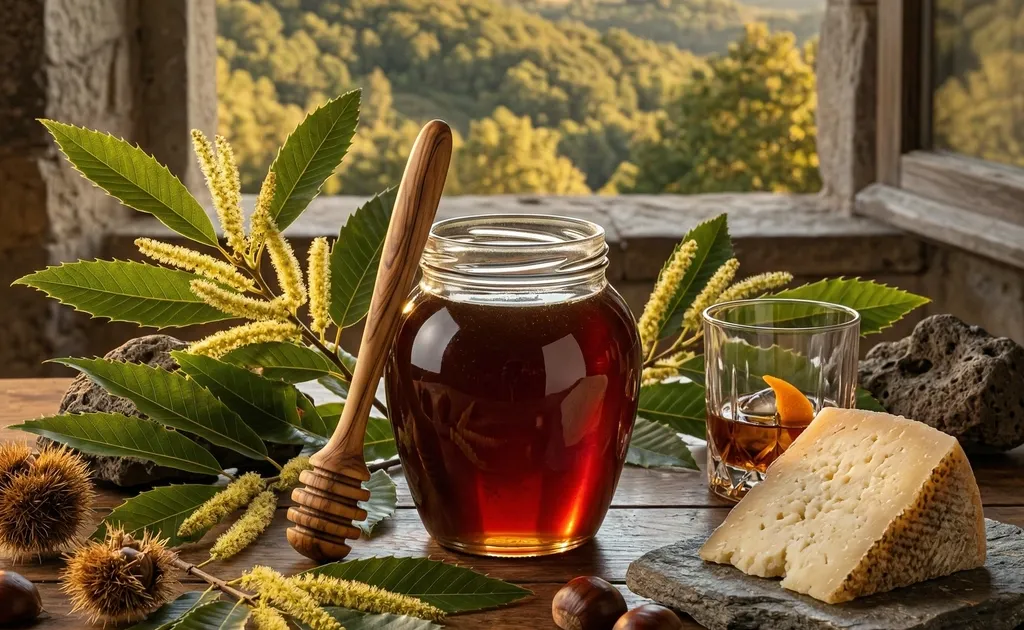
Chestnut Honey from the Monti Cimini: The Volcanic Essence of Lazio
In the architecture of haute gastronomy, few products manage to incarnate the geological and botanical identity of their territory with the same disarming power as Chestnut Honey from the Monti Cimini. Far removed from the reassuring, delicate sweetness of spring honeys, this apiary Grand Cru stands as an obscure, complex, and aristocratic sensory monument. It is the liquid expression of a primordial, volcanic terroir, a biochemical masterpiece that challenges palatal conventions to assert itself as a meditative ingredient and a pillar of Lazio’s haute cuisine.
The Monti Cimini: A Volcanic Terroir of Excellence
The greatness of an agricultural cru lies inexorably in the soil that nourishes it. In the heart of the Tuscia Viterbese, the Monti Cimini mountain complex offers an ecosystem whose geological history has forged an unparalleled pedoclimatic stage.
How does the volcanic geology of the Monti Cimini influence the composition of chestnut honey?
The volcanic geology of the Monti Cimini enriches the soil with potassium, phosphorus, and manganese—minerals that are absorbed by the chestnut tree’s sap and transferred to the nectar. This confers upon the honey an exceedingly high electrical conductivity, a pronounced sapidity, and an extraordinary concentration of polyphenols and tannins.
Delving into the genesis of this phenomenon, the ancient Vico volcano bequeathed soils composed of tuffs, ignimbrites, and millennia-old ash. This substrate, exceptionally well-draining and rich in trace elements, represents the perfect habitat for the development of the chestnut tree. The plant’s roots, driving deep into these effusive rocks, extract a sap electrically and minerally charged. When bees forage on the flowers of these woodlands, they are not merely collecting a sugar solution; they are stockpiling the exact mineral fingerprint of the ancient crater. This chemical translation from magma to nectar is the foundational secret behind the gustatory three-dimensionality of the finished product.
The centuries-old Castanea sativa woodlands in northern Lazio
The slopes of the Monti Cimini, from 400 to over 1,000 metres in altitude, are cloaked in monumental forests of Castanea sativa. These are not mere cash crops, but centuries-old coppices and high forests forming a homogeneous and imposing ecosystem. The purity of the air and the isolation of these forests from major traffic arteries or intensive lowland agriculture guarantee the bees a pristine foraging environment. The absence of pollutants ensures the nectar suffers no chemical interference, preserving intact the fragile volatile organic compounds (VOCs) that will define the aromatic bouquet of the raw honey.
Botany and the Chestnut Bloom
The production process of chestnut honey is a race against time, a phenological window that is brief yet of unprecedented intensity, demanding perfect timing and efficiency from both bee colonies and beekeepers.
Bloom times: Between June and July
The anthesis of the chestnut tree occurs at the height of summer, usually between the second half of June and the first weeks of July. The male flowers, gathered in long catkins (erect, yellowish-green spikes), release a pungent, almost spermatic scent that saturates the undergrowth air. It is within these three or four weeks that the destiny of the beekeeping vintage is decided. The floral explosion is so massive that the woodlands appear to be covered in a golden fuzz, visible even from kilometres away.
The abundance of nectar and pollen: The tireless work of the bees
Castanea sativa is a superbly generous plant, defined in botany as “nectariferous-polliniferous” of primary importance. The flowers secrete industrial quantities of dense, sugary nectar, whilst the anthers release clouds of hyper-proteic pollen.
The bees react to this abundance with unparalleled foraging frenzy. The colonies, now at the zenith of their annual demographic development (exceeding 60,000 individuals per hive), work ceaselessly from dawn to dusk. Chestnut pollen, being over-represented, inevitably ends up in the nectar: the melissopalynological analysis of a pure Monti Cimini Cru regularly reveals chestnut pollen grain percentages exceeding 85-90%.
Seasonal variability: The influence of summer rains
The greatness of this nectar is inextricably linked to meteorological caprice. Lazio’s summer climate plays a decisive role:
- Restorative Rains: Brief, intense summer storms wash the leaves, but above all, they lower nocturnal temperatures, allowing the plant to recover its cellular turgor and restore nectar secretion the following day.
- Extreme Drought: Prolonged heatwaves (over 35°C) without precipitation trigger water stress. The flowers “burn”, halting nectar production. However, the meagre amount of honey extracted in these hot vintages will be extraordinarily dense, with an exasperated phenolic component and astringency, creating collectable vintages for absolute connoisseurs.
Organoleptic Profile and Sensory Analysis
Tasting Chestnut Honey from the Monti Cimini requires a reset of one’s expectations. Abandoning the conception of honey as a sweetener, one delves into the analysis of a structural ingredient, whose complexity demands the expertise of a sommelier.
Visual Examination: Dark amber, reddish reflections, and resistance to crystallisation
To the eye, the cru poured into the tasting glass or onto the white ceramic spatula manifests with a silky limpidity and abyssal chromatics. On the Pfund Scale, it easily exceeds 100 millimetres. The colour is a dark amber verging on mahogany or walnut husk, embellished against the light by vivid reddish and ruby reflections. The total absence of crystallisation-induced turbidity makes it a visually fascinating and magnetic product.
Olfactory Examination: Pungent notes, damp wood, leather, and smoke
The orthonasal impact is powerful, masculine, and divisive; it is a honey that does not seek to please, but to assert its volcanic identity. The array of volatile organic compounds escapes classic floral descriptors to embrace the phenol family.
- Primary Notes: Damp undergrowth, wet bark, moss, and fermented hay.
- Secondary Notes: Distinct evocations of Russian leather, dark tobacco, bitter cocoa bean, and, occasionally, subtle echoes of smoke or cold ash. A complexity that immediately recalls the barrique ageing of great spirits.
Gustatory Examination: Low sweetness, elegant tannin, and bitter persistence
On the palate, the olfactory promise materialises into an austere gustatory architecture.
- The entry is warm and viscous, but the sweet component is instantaneously assaulted and overpowered by a distinct and noble bitter front.
- The sapidity, derived from the high mineral presence, enhances the contrasts.
- The most fascinating trait is the tactile sensation of astringency: the natural tannins of the chestnut dry the palate (in a manner akin to a highly structured red wine), leaving the mouth impeccably clean and primed for a long, interminable bitter aftertaste reminiscent of cinchona, rhubarb, and gentian.
Reference Biochemical Data
Haute sommellerie certifies organoleptic quality by cross-referencing it with the chemical laboratory’s report. Chestnut Honey is a matrix boasting world-class analytical parameters.
Why does artisanal chestnut honey naturally maintain a perpetually liquid state?
Chestnut honey maintains a perpetually liquid state due to its exceptional chemical ratio of sugars, dominated by an exceedingly high percentage of fructose relative to glucose. This biochemical composition prevents supersaturation and the subsequent precipitation of crystals over time.
While other honeys require meticulous storage at 14°C to manage crystallisation, chestnut boasts a Fructose/Glucose (F/G) ratio that amply exceeds the value of 1.3, frequently reaching 1.5 or 1.6. Fructose, highly soluble and hygroscopic, firmly retains the natural moisture within its molecular mesh, preventing the glucose from aggregating and forming a solid lattice. This perpetual fluidity is therefore not the result of industrial pasteurisation, but an exclusive gift of the plant’s genetics.
High electrical conductivity: The richness of mineral salts
A distinctive analytical parameter of this Cru is its electrical conductivity. Measured in milliSiemens per centimetre (mS/cm), it evaluates the aqueous solution’s capacity to conduct current, which is directly proportional to the presence of mineral salts and organic acids. Whilst pale honeys (such as Acacia) present negligible values (0.1 - 0.2 mS/cm), Chestnut Honey from the Cimini records exceedingly high values, consistently above 0.8 mS/cm, often settling beyond 1.2 mS/cm. This mineral “charge” is the numerical translation of the volcanic soil, the fingerprint of the magma transferred into the glass.
Typical Diastase and HMF for dark forest honeys
Dark honeys, rich in polyphenols and mineral substances, physiologically present exceptional biochemical energy. The Diastase Index (a measure of the active diastase enzyme) in a cold-extracted raw chestnut honey is typically explosive, easily exceeding 20 or 30 Schade units. Simultaneously, the rigorous protocol of natural settling guarantees an HMF Index (Hydroxymethylfurfural) near zero, certifying the total absence of thermal stress and ensuring the absolute integrity of the VOCs and the original antioxidant profile.
Haute Sommellerie Pairings
The employment of Chestnut Honey from the Monti Cimini in haute cuisine demands courage and competence. It does not tolerate delicate pairings or sweet-on-sweet concordance; it demands contrast, trigeminal challenge, and the encounter with raw materials endowed with its same imposing presence.
The perfect contrast with aged pecorinos (e.g., Caciofiore di Columella)
The stage of choice for this honey is the trolley of exceptionally long-aged Lazio cheeses.
- The Pairing: Served in drops over flakes of extra-mature Pecorino Romano DOP, Pecorino di Picinisco, or the exceedingly rare Caciofiore di Columella.
- The Chemical Dynamic: The extreme sapidity and umami fattiness of the cheese are pierced and cleansed by the honey’s tannic astringency. The bitterness of the chestnut melds with the pungency of the evolved sheep’s milk, cancelling each other out and triggering the genesis of a novel third flavour, characterised by notes of toasted walnut, dried mushrooms, and undergrowth.
Culinary applications: Glazes for dark meats and game
In Michelin-starred kitchens, this honey becomes a pillar for cooking dark meats. Utilised in marinades or for the final lacquering of wild boar, hare, or duck, chestnut triggers a controlled Maillard Reaction. Its leathery and smoky notes penetrate the meat fibres, whilst the absence of intrusive sweetness guarantees a dense, glossy pan sauce with a profoundly deep and perfectly balanced aromatic profile.
Mixology: Synergy with barrel-aged spirits (Whisky, Rum)
The vanguard of international mixology has identified in chestnut an unparalleled structural sweetener. Master bartenders utilise raw Chestnut Honey syrups to balance cocktails based on Bourbon, Rye Whisky, or aged Rhum Agricole. The phenolic molecules of the honey bind in perfect consonance with the vanillin and lactones released by the wood of oak barrels, creating Old Fashioneds of unapproachable depth and gustatory length.
Conclusion: The most intense expression of the Lazio woodlands
Chestnut Honey from the Monti Cimini is not a product for timid palates. It is a manifesto of territorial identity, a complex and challenging biochemical architecture that rejects any industrial compromise.
Choosing this volcanic Grand Cru means bringing to the table the very essence of the Tuscia: the majesty of the centuries-old woodlands, the feverish work of the bees in the torrid Viterbo summers, and the memory of a magmatic soil millennia old. For haute gastronomy, to serve and savour this raw honey, respecting its enzymatic and aromatic integrity, represents the highest and most sincere tribute to the brutal and sublime elegance of Lazio’s nature.