Bees as Bioindicators in the Lazio Region
How bees act as living environmental sensors for air quality and biodiversity in the Lazio region.
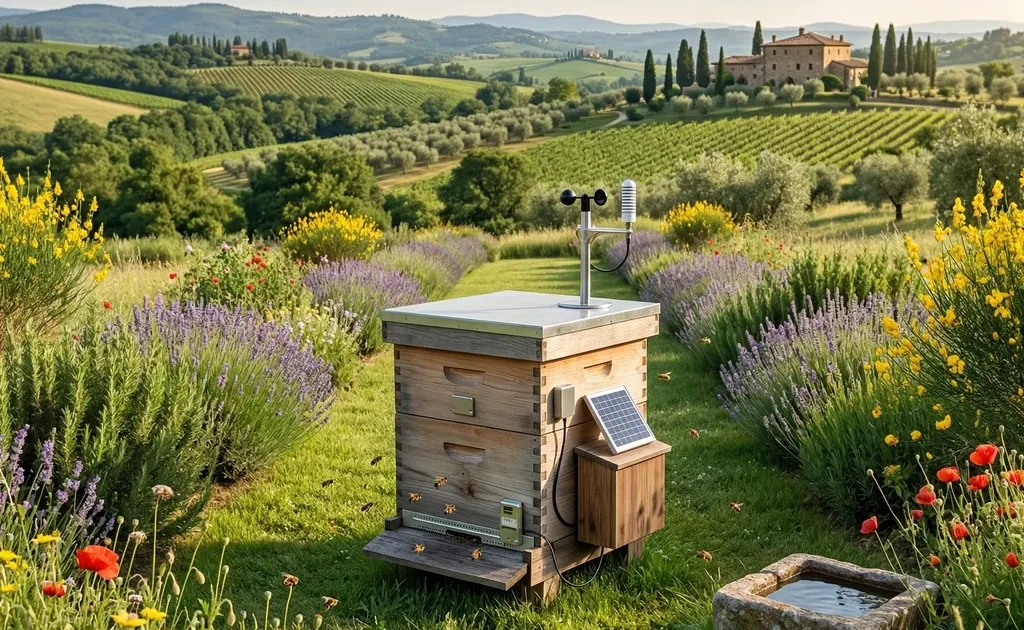
Bees as Bioindicators: The Living Sensors of the Terroir
In the realm of haute gastronomy, the purity of the terroir is the indispensable prerequisite for creating a luxury product. Even before honey reaches the tasting glass to unveil its complex volatile organic compounds (VOCs), the surrounding environment dictates its qualitative potential. In this ceaseless pursuit of perfection, bees are not merely producers, but rigorous ecological inspectors.
The Concept of a Bioindicator in the Ecosystem
Haute apiculture is not limited to the extraction of a sugar matrix; it encompasses the scientific reading of the ecosystem through the colony’s activity. Understanding this delicate equilibrium is what separates a commercial honey from a true botanical Grand Cru.
What does “Bioindicator” mean? Scientific definition
In ecology and environmental biology, a bioindicator is an organism (or biological system) whose behavioural, physiological, or numerical variations are utilised to assess alterations in environmental quality. Unlike chemical or electronic sensors, which passively measure specific molecules at an exact point, a bioindicator offers an integrated, cumulative, and dynamic analysis of an entire habitat’s state of health.
The presence, absence, or health status of these “sentinel” species reflects the combined impact of multiple stressors, from fluctuations in the pedoclimate to the presence of synthetic contaminants. In the premium agri-food sector, employing bioindicators means certifying the authenticity and pristine nature of the terroir from which the final product will originate.
Why is Apis mellifera considered the perfect environmental monitor?
Apis mellifera is considered the perfect environmental monitor due to its exceptional mobility, its dense electrostatic pubescence that traps atmospheric particulate matter, and its high number of daily samplings. Through foraging activity, the colony conducts a systematic and continuous screening of air, water, and vegetation.
Delving into the specifics of this superb natural engineering, the bee’s perfection as an analytical tool derives from its biology. A single colony houses tens of thousands of foraging individuals. Every bee undertakes multiple daily flights, alighting upon thousands of floral corollas. During these landings, the insect intercepts not only nectar and pollen but also any foreign particle suspended in the air or deposited on plant surfaces, from marine aerosol to chemical residues.
The foraging radius: Mapping 30-square-kilometre areas per hive
The efficacy of the environmental mapping performed by bees lies in the breadth of their operational radius. A healthy colony systematically patrols an area extending for an average radius of approximately 3 kilometres around the hive. This translates into an investigation area of nearly 30 square kilometres (roughly 2,800 hectares).
Within this vast perimeter, scout bees sample every available resource, acting as a network of ultra-high-density micro-sensors. Any alteration in the territory’s physicochemical equilibrium—be it a pristine woodland in the Monti Lucretili or an intensive agricultural zone—is registered and physically transported into the hive, becoming measurable through precise laboratory analyses on apiary matrices.
What Do Bees “Record” on Their Flights?
The level of detail an environmental survey conducted via bees can achieve is staggering. The matrices extracted from the hive (dead bees, pollen from traps, wax, and honey) provide a chemical report of exceptional precision.
Microplastics and heavy metals: Traces in the air and water
Atmospheric and water pollution leave unequivocal traces. Bees, requiring substantial quantities of water to thermoregulate the hive during the summer months, draw liquids from puddles, canals, and dew. In this process, they ingest and bioaccumulate heavy metals (such as lead, cadmium, chromium, and nickel) stemming from vehicular traffic or industrial emissions.
Recently, scientific research has highlighted how the bees’ pubescence is capable of intercepting and retaining fragments of airborne microplastics and nanoplastics. The absence of these pollutants in melissopalynological and chemical analyses is the first major certification of prestige for a raw honey intended for haute gastronomy.
Phytopharmaceuticals and synthetic pesticides: Detection on agricultural crops
The modern agricultural sector makes extensive use of synthetic molecules, such as neonicotinoid insecticides, fungicides, and herbicides. Bees are exquisitely sensitive to these phytopharmaceuticals, which act upon their central nervous system, disorienting them and altering their complex communication dance.
Analysing the pollen stored in the honeycombs allows for the precise identification of the exact types of molecules utilised in the surrounding crops. An ethical, premium honey cannot originate in areas where intensive agriculture saturates the soils and inflorescences with synthetic chemicals, as these would be irretrievably incorporated into the product, compromising its integrity and organoleptic purity.
Urban pollution indices (PM10) in biomonitoring networks
Fine particulate matter (PM10 and PM2.5), generated by urban combustion processes, settles on leaves and flowers. Bees inadvertently collect it. By examining dead bees gathered using specially designed cages placed at the hive entrance, scientists can quantify exposure to atmospheric particulate, utilising the hives as bona fide air quality monitoring stations—often far denser and more capillary than the mechanical ones managed by regional environmental agencies.
Environmental Monitoring in Lazio
The Lazio region presents a complex geography, where pristine rural areas, large agricultural districts, and one of Europe’s most sprawling metropolises coexist. This marked dichotomy makes the Lazio territory a perfect laboratory for apiary biomonitoring.
How does environmental monitoring via bees function in the Lazio territory?
In the Lazio territory, environmental monitoring occurs through a network of sentinel hives deployed across rural areas and peri-urban belts. The cyclical analysis of dead bees, foraged pollen, and raw honey analytically detects the concentration of pollutants, yielding an extraordinarily precise and updated map of the region’s ecosystemic quality.
This control system makes it possible to draw a clear line between zones suitable for luxury honey production and those severely compromised. The network of biological stations highlights pollution peaks in real-time, guiding the artisanal beekeeper towards transhumance (nomadic beekeeping) into areas where the pedoclimate and air remain crystalline—a fundamental requirement to protect the sensory architecture of monofloral honeys.
Comparison between urban sampling and protected area sampling
Roman haute cuisine demands a product with identity, but provenance makes all the difference. Samplings conducted in urban contexts, whilst yielding exotic blooms and surprising honeys due to high urban biodiversity, frequently present critical issues linked to the accumulation of heavy metals and fine particulate matter.
Conversely, positioning apiaries in protected areas (such as the Lake Vico Nature Reserve, the forests of the Monti Cimini, or the green heart of the Agro Pontino) guarantees the collection of pure nectars. In these biodiversity oases, analytical values consistently return absolute zero for industrial contaminants, allowing chestnut or eucalyptus honey to express their vibrant, intact, and supremely elegant phenolic or balsamic notes.
How the purity of honey reflects the health of the surrounding territory
An unpasteurised raw honey, cold-extracted, is a chemical hologram of its environment. The territory’s health directly reflects upon the vitality of the product. In an unpolluted environment free from chemical stress, the colonies maintain an exceedingly high metabolic vigour, which translates into an extraordinarily rich enzymatic profile (assessable via diastase and invertase activity).
The absence of contaminants ensures that the sophisticated processes of natural acidification (mediated by gluconic acid) and aromatic synthesis remain unaltered. This allows the end consumer to savour a product whose low HMF Index (Hydroxymethylfurfural) attests not only to the correct artisanal extraction process but also to its origin within a healthy and resilient biosphere.
From Alarm to Action: The Ethics of the Beekeeper
The role of a beekeeper dedicated to excellence is not simply that of an extractor, but of a true landscape architect and guarantor of quality. The data gathered by the bees must be translated into agronomic practices and uncompromising operational choices.
Strategic positioning of apiaries away from polluting sources
The first step to obtaining a gastronomic Cru is the meticulous selection of the site. Stationary apiaries intended for premium productions are situated in geographically isolated zones, deliberately chosen to keep the 3-kilometre foraging radius strictly clear of high-traffic ring roads, industrial hubs, or monocultures subjected to massive chemical spraying. Geographical isolation is the primordial luxury that guarantees a sensory profile devoid of any olfactory or gustatory “background noise”.
Collaboration between beekeepers and farmers for virtuous practices
Protecting biodiversity in Lazio requires synergy. Haute apiculture forges ethical pacts with neighbouring farms that practice organic, biodynamic, or regenerative agriculture. This virtuous circle guarantees farmers a top-tier pollination service (increasing the yield and quality of orchards and native seeds) and offers bees safe floral pastures, free from glyphosate and fungicides, thereby fostering the production of extraordinary Wildflower (Millefiori) honeys of unrivalled complexity.
Monitoring colony mortality as an alarm bell
A sudden depopulation or anomalous mortality in front of the hive (a phenomenon known as acute depopulation) is not merely an economic tragedy for the beekeeper; it is an ecological alarm for the entire community. Monitoring these events means mapping and reporting territorial imbalances, actively defending the ecosystem that serves as the cradle for local gastronomic excellences.
Wax as an Environmental Sponge
If pollen and honey photograph temporary pollution, wax constitutes the historical archive of the hive. The choices made regarding this material radically differentiate high-end apiculture from conventional practices.
Why does beeswax tend to accumulate lipophilic polluting substances?
Beeswax accumulates lipophilic polluting substances due to its complex chemical nature, primarily consisting of esters, free fatty acids, and long-chain hydrocarbons. This dense, lipidic matrix acts as a sponge, permanently absorbing and retaining synthetic molecules and phytopharmaceuticals dispersed in the environment.
When bees store contaminated pollen and nectars in the hexagonal cells, or when a conventional beekeeper uses chemical treatments within the hive, the (highly lipophilic) polluting molecules migrate and bind stably to the wax. The standard beekeeping industry continuously recycles this melted wax to create new foundation sheets, concentrating the level of pollutants year after year, establishing a saturated environment that risks contaminating even the purest honey through osmosis.
The importance of exclusively using capping wax in organic cycles
To guarantee a product of absolute excellence and adhere to the strict canons of professional tasting, an elite beekeeper renews the honeycombs using exclusively their own capping wax (cera d’opercolo).
The capping is the incredibly thin layer of virgin wax that bees secrete (via their wax glands) to seal the cells once the honey has reached optimal moisture. This wax is newly synthesised, exceptionally pure, white, and uncontaminated. Melting it down and reusing it to press the foundation sheets for the following season eliminates the risk of chemical bioaccumulation, ensuring a perfect “vessel” to house and preserve the aromas, polyphenols, and complex sugar architectures of the Lazio nectar.
Conclusion: Protecting the bee to protect mankind
Employing bees as bioindicators transcends academic interest and positions itself at the very core of the most modern and conscious gastronomic philosophy. A honey that has passed the cross-examination of these tireless environmental sensors is not solely a safe foodstuff, but a living manifesto of ecological resilience.
Choosing to bring to one’s table, or into the selection of a luxury restaurant, a traceable, raw artisanal honey sourced from ethical supply chains is an act of profound culture. It means financing environmental monitoring, rewarding the safeguarding of Lazio’s spontaneous blooms, and ultimately recognising that the protection of biodiversity and the pursuit of absolute gustatory excellence are two sides of the same invaluable coin.